David Attenborough: A Life on Our Planet
Let's start easy... The famous naturalist David Attenborough is probably one of the earliest crusaders in favor of the environment and biodiveristy. His book (and subsequent film), "A Life on Our Planet" is a must read, to take a step back and get a more holistic view to the climate change problems that we read about everyday. Check the trailer of his film, that you can watch on Netflix : https://www.ourplanet.com/en/video/david-attenborough-a-life-on-our-planet-trailer/
Further down, let's have a look at how critical our Earth condition is with 6 of 9 Plantary boundaries breached...
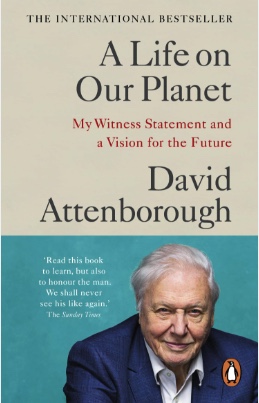
In 2020, world-renowned naturalist David Attenborough released a new film –"A Life on Our Planet"– which he calls his “witness statement” for the environment. The film traces his 60-year career, outlining how steeply the health of the planet has declined in his lifetime. It also makes grim predictions for the future should humanity continue on its current path. Here are some of the key takeaways and predictions from A Life on Our Planet.
David Attenborough maps out how humanity’s wanton destruction of nature will render the planet totally degraded and barren, uninhabitable for millions of people and bringing biodiversity populations crashing. Since the 1950s, animal populations have more than halved, while domestic birds’ populations have skyrocketed; 70% of the mass of the birds on the planet are domestic birds- mostly chickens. Humans account for over one-third of the weight of mammals on Earth. A further 60% of animals are those that are raised for us to eat. The rest- “from mice to whales”- make up just 4%. Domestic animals require vast swathes of land and half of the fertile land on the planet is now farmland.
Humans cut down up to 15 billion trees per year; this is just one facet of the planet’s degradation thanks to humans, which has resulted in 30% of fish stocks being fished to critical levels and freshwater populations declining by over 80%. The Arctic, one of the coldest and remote places on Earth, has experienced summer sea ice reducing by 40% in 40 years.
David Attenborough makes horrifying predictions for the 2030s, 2040s, 2050s, 2080s and 2100s:
2030s
If deforestation in the Amazon rainforest continues, it will degrade to a point where it can no longer produce enough moisture, transforming into a dry savanna. Not only will this decimate the biodiversity in the rainforest, but it will also alter the global water cycle.
Additionally, the Arctic will start experiencing ice-free summers. Without the white ice caps, less of the sun’s energy will be reflected back into space, which will accelerate global warming.
2040s
In the North, frozen permafrost soils will thaw, releasing methane into the atmosphere.
2050s
As oceans continue to heat and become more acidic, coral reefs around the world will bleach and die. This will cause fish populations to crash, which will affect millions of people who rely on the ocean for their livelihoods.
2080s
Global food production will enter into a crisis as soils become exhausted by overuse. Pollinating insects will disappear and the weather will become more unpredictable.
2100s
The planet will be four degrees Celsius warmer, rendering large parts of the Earth uninhabitable and leaving millions of people homeless. Scientists predict that the sixth mass extinction will be well underway at this point, causing irreversible damage to the planet. The security and stability of the Holocene era- our “Garden of Eden,” as Attenborough calls it, will be lost.
What Can We Do?
All hope is not lost however, David Attenborough asserts. We still have time to halt and even reverse the damage we have caused to the planet. The film lays out several fairly simply and feasible solutions, including:
1. Stabilise the Global Population
We need to slow the rate at which the global population is growing; by 2100, the population is expected to reach 11 billion people. To slow the population growth rate, we need to raise people out of poverty, improve access to healthcare globally and enable children, especially girls, to stay in school for as long as possible.
2. Shift to Renewable Energy
We need to shift to renewable energy, a process which is already happening at a rapid- albeit not rapid enough- pace. At the turn of the century, Morocco relied on imported oil and gas for almost all of its energy. Today, it generates 40% of its needs at home from renewable sources, boasting the world’s largest solar farm. With its rapid advancements in this area, Morocco could be an energy exporter by 2050. Globally, renewable energy may be the dominant source of energy in 20 years. David Attenborough calls for divestment from fossil fuels, and points out the irony of banks and investment firms investing pension funds in fossil fuels when it’s these dirty fuels preventing the future that we are saving for.
3. Restore Biodiversity
We need to restore-or “rewild”- biodiversity on the planet. When ecosystems are more diverse, they are better able to perform essential ecosystem services, like carbon sequestration. An example of this is the oceans. Palau is a western Pacific island nation dependent on its oceans for food and tourism. When fishing stocks were rapidly depleting, the government restricted fishing practices and banned fishing entirely in some areas. The protected fish populations soon became so healthy that they spilled into areas where fishing was allowed. These no-fish zones resulted in increased catches for fishermen and recovered coral reefs. Globally, if no-fish zones were implemented over a third of the world’s oceans, we would have all the fish we would need. The UN is trying to do just that- create the largest no-fish zone in international waters.
Additionally, we need to reduce the space we use for farmland to instead make space for returning wilderness. The easiest way to do this is to change our diets. If we all had a largely plant-based diet, David Attenborough says, we would need half the land we use now. In nature, large carnivores are fairly rare; for every predator on the Serengeti, there are more than 100 prey animals. The Netherlands is one of the world’s most densely populated countries. This has forced Dutch farmers to use land much more efficiently. Through creative and innovative changes to farming practices, in two generations, the nation has raised yields tenfold while using less water, fewer pesticides and fertilisers and emitting less carbon. Today, the Netherlands is the world’s second largest exporter of food.
4. End Deforestation
Finally, we need to halt deforestation as forests are the planet’s biggest ally in locking away carbon. Further, forests must be more biodiverse as this will make them more effective at absorbing carbon. Crops like oil palm and soya should only be grown on land that was deforested long ago. The example of Costa Rica is used. A century ago, more than three-quarters of the nation was covered with forest. By the 1980s, thanks to rampant deforestation, this was reduced to one quarter. The government intervened, giving grants to landowners to replant native trees. Thanks to this initiative, forests now cover half of Costa Rica once more.
The problem is immense, but we already have the knowledge and skills to halt and reverse it. We need to reexamine our relationship with nature, working with it instead of against it, to restore our planet to its former glory.
