History
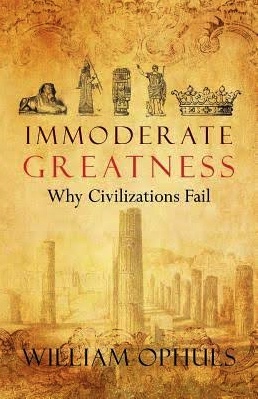
Let's start by taking a look at what has made civilisations fail and empire collapse... Two books have meant a lot to me in ploughing through these topics : "After Tamerlane, The Rise and Fall of Global Empires 1400-2000" by John Darwin and "Immoderate Greatness, Why Civilizations fail" by William Ophuls. I have chosen some excerpts below
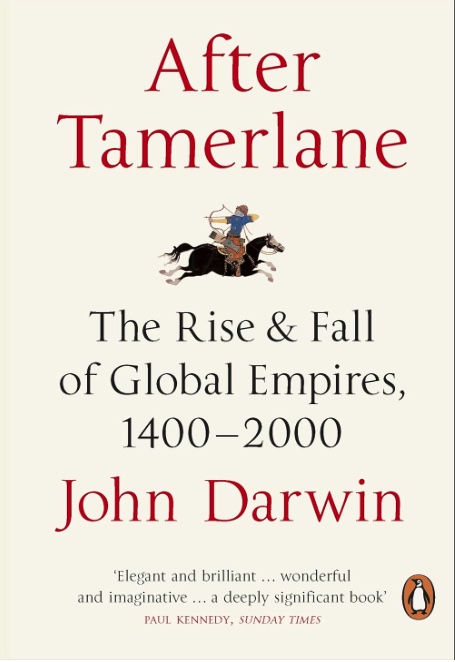
- The End of Empires
To say that no empire is eternal is a historical truism. The collapse could have had all kinds of causes.
When an empire relied on the collaboration or loyalty of subjugated elites, timely rebellion or resistance could inflict irreparable damage on its prestige or authority.
The need to appease recalcitrant allies could cause a slow but ultimately fatal erosion of the means of control.
If the exercise of imperial power presupposed the approval of public opinion in the imperial metropolis or placed additional burdens on its wealth or its workforce, it is the revolt of the center rather than that of the periphery, which could be decisive in bringing down an empire.
New ideologies or religions could destroy the moral and political credit on which the empire based its legitimacy, the idea that it was part of the natural order of things.
There was another fairly common danger: when the weight of the empire's commitments became too heavy to bear and abandoning them too difficult a decision to make. The excess weight of the empire drained the material forces of the empire and could tempt rivals.
Empires could also be exposed to economic and environmental hazards. The resources and techniques on which their power rested could dry up or become obsolete. Material wealth and technical success could dissipate or move to more favorable locations.
Perhaps worst of all, empires could descend into wars of mutual destruction in which the search for local advantage willy-nilly led to world-changing upheavals.
Even short of such a doomsday scenario, an insidious risk was at work in most Imperial systems. It was almost inevitable that the summit of power would fall into the hands of closed elites who entrenched themselves there. They ended up transforming the imperial structure into a semi-private domain organized to serve their particular interests. They enlisted the support of other factions and groups to form a grand coalition to defend a status quo from which they were the main beneficiaries. This refusal of evolution was a fatal error because the price of an empire was precisely the continual adaptation to internal, colonial and external pressures and the skillful exploitation of innovations that appeared in the cultural or economic domain.
Niccolo Machiavelli :
« Wise men say, and not without a reason, that whoever wishes to foresee the future must consult the past; for human events ever resemble those of preceding times. This arises from the fact that they are produced by men who ever have been, and ever will be, animated by the same passions, and thus they necessarily have the same results. »
- Human Nature
There is no escape from our all-too-human nature. In the end, mastering the historical process would require human beings to master themselves, something they are very far from achieving.(This is why democracy, considered by some to be an asset in the struggle against the forces that challenge industrial civilizaton, is in fact a liability).
- End of Civilizations
o Because civilization is not natural, sustaining it entails a continuous input of matter, energy and morale without which it would necessarily decline or even collapse. The end of progress is necessarily the beginning of decline.
o The central institution of civilization exists, and can only exist, by systematically exploiting its rural and natural periphery. It is this exploitation, that supports the higher level of social and economic complexity that characterizes civilization. The city is an ecological parasite, and by its nature, parasites debilitate or even destroy their host, so the outcome of this one-way, one-sided process is bound to be damaging in the long term. Thus, every known civilization has caused environmental harm and ecological degradation to some degree.
o It is in the nature of civilization to wax greater. In a positive feedback loop, the ready availability of virgin resources generates a larger, wealthier population that consumes more; increased demand then spurs further resource development, and so on.
o In pursuing greatness, human beings are only expressing their biological nature. Biological evolution is driven by the tendency of all creatures to expand their habitat and exploit the available resources, just as bacteria in a Petri dish grow until they have consumed all the nutrients and then die in a toxic soup of their own waste. Those who are the most successful in doing so win the evolutionary race. Thus, we humans do what all creatures do, and we have so far been a notable success. However, as the Petri dish suggests, the final outcome may not be so benign once we have consumed our own ecological « nutrients ».
o The human mind is still fundamentally Paleolithic . That is, it was hardwired by evolution for the life of a hunter gatherer on the African Savannah, a life centered on day-to-day survival in small bands of intimates and kinsmen. In practice, this means that human beings excel at concrete perception but are much less adapt at abstraction. And they are quick to perceive the immediate and dramatic but likely to overlook long-term trends and consequences. They are therefore strongly present oriented and tend to neglect or devalue the future.
o Species, people, firms, governments are all complex entities that must survive in dynamic environments that evolve over time. Their ability to understand such environments is inherently limited… These limits are a fundamental feature of all complex systems and can no more be overcome by smarter analysis than we are able to break binding physical constraints, such as our inabillity to travel faster than, the speed of light. This is why things fail. Paul Ornerod in « Why Most Things Fail »
o Civilizations are trapped in a vicious circle. They must keep solving the problems of complexity, for that is the price of civilized existence, but every solution creates new, ever more difficult problems, which then require new, ever more demanding solutions. Thus complexity breeds more of the same, and each increase in complexity makes it harder to cope, while at the same time escalating the penalty for failure. In effect, civilizations enact a tragedy in which their raison d’être- the use of energy to foster the complexity that raises them above the hunter-gatherer level of subsistence- becomes the agent of their ultimate downfall.
o Like Gulliver, civilization finds itself tied down by a multitude of vested interests – physical, social, economic, financial, political, and psychological. Enmeshed in this legacy of the past, it cannot save itself. Even if the will to change existed, it would take prodigious effort and many decades to overcome the legacy, but the will is lacking. The elites may understand that the system is dysfunctional, but fundamental reform would require major sacrifice on their part, so they fight to preserve their privilege and power instead. Increasingly polarized, they dissipate their energy in factional struggle instead of problem solving. Besides, says Ronald Wright, « They continue to prosper in darkening times long after the environment and general populace begin to suffer ». In the end, the elites prefer an advatageous present, however problematic, to an uncertain and possibly disadvantageous future.
o Reducing the process to its essence, a civilization declines when it has exhausted its physical and moral capital. A civilization begins with abundant resources, inspiring ideals, strong morals, solvable problems , and high morale. "Green and fresh », it accumulates wealth and power. However, its rise to dominance also prepares its downfall, for although greatness brings « bustle and abundance », it also entails scarce resources, faded ideals, loose morals, intractable problems, and in consequence, lost morale. In addition, «because the « general tendency of wealth and power is to enervate a people, to make them proud and indolent », they succumb to hubris and become the authors of their own demise. Every civilization, therefore ends « all… trampled, down , barren and bare ».
o Today, ecological problems, exponential pressures, thermodynamic losses, risky complexity, moral decay, and human incapacity are evident everywhere, differing only in extent and degree among the various regions and societies that make up modern industrial civilization.
· Moral Decay
« I must study politics and war, so that our sons may have liberty to study mathematics and philosophy. Our sons ought to study mathematics and philosophy, geography, natural history and naval architecture, navigation, commerce and agriculture, in order to give their children the right to study painting, poetry, music, architecture, statuary, tapestry and porcelain. » John Adams
At first glance, Adam’s aspiration seems laudable. After all, what is the point of civilization if not to be become « civilized » ? But if all the grand children are poets, painters and connoisseurs, who then will man the ramparts, dig the mines, build the dams, run the factories, keep the accounts, or teach the children ? In other words, dirty their hands doing the hard and necessary work of preserving the civilization’s political, social, ecionomic, and technological base ? Yet precisely this progression from dutiful soldier to effete poet – from vigor and virtue to decadence and decay – has been a factor in the decline of every known civilization.
That civilizations decline has been understood since ancient times. Many historians, philosophers, seers and poets have attempted to describe the cycle of history and capture its driving forces . Hesiod, Plato, Polybius, Ibn Khaldun, Gianbattista Vico, Gustave Le Bon, Oswald Spengler, Pitirim Soroki, and Arnold Toynbee are just a few of the most noted. However, none have captures the course of decline quite so succinctly as Sir John Glubb, better known by his nom de guerre Glubb Pasha.
In Glubb’s view, the history of civilizations decribes an arc, that starts with an Age of Pioneers (or Conquets) and then moves successively through the Ages of Commerce, Affluence, and Intellect, before terminating in an Age of Decadence. Two implacable forces propel this movement. First, in a process analogous to ecological succession, each age creates socioeconomic conditions favorable to to the emergence of the next. Second, each new generation therefore grows up in altered circumstances, that foster a changed way of thinking and acting. The outcome is a positive feedback loop in which changed material conditions engender mental changes that foster still more material change, and so on, until the civilization declines into decadence.
The Age of the Pioneers is characterized by « unresting enterprise » and « fearless initiative ». Because « glory and honour are the principal objects of ambition », conquistadors hack their way through jungles, climb mountains, or brave the oceans in tiny cockle-shells pursuing them. « Abounding in courage, energy and initiative », they overcome every obstacle to found an empire, often overwhelming more numerous and better armed opponents by sheer élan. Having done so, the pioneers quickly appropriate the most useful aspects of conquered or neighboring cultures to achieve state-of-the art military, technological and administrative sophistication. But they maintain their pioneer virtues – above all optimism, confidence, devotion to duty, a sense of honor, a shared purpose, and adherence to a strict morale code. Succintly put, morale is high and consensus strong.
The consequence of imperial rule is political stability over a wide geographic area as well as general economic conditions for manufacture and trade. As the merchant class grows wealthier, it gradually adopts more and more of the prestige and power belonging to soldiers and statesmen. An Age of Commerce therefore succeds the Age of Pioneers. During the first half of this new phase, says Glubb, « The ancient virtues of courage, patriotism and devotion to duty are still in evidence. The nation is proud, united, and full of self-confidence ». In addition, « daring initiative is shown in the search for profitable enterprises in the far corners of the earth, perpetuating to some degree the adventurous courage of the Age of Conquests ».
This happy combination of adventurous courage and commercial prowess cannot last. As wealth piles up, the populace is gradually seduced by riches and softened by luxury. « Money replaces honor and adventure as the objective of the best young men », and an Age of Affluence succeeds the Age of Commerce.
The civilization is now at its peak. « The immense wealth accumulated in the nation dazzles the onlookers, and enough of the ancient virtues of courage, energy and patriotism survive » to make the society seem both glorious and impregnable. But beneath the surface, greed and selfishness crowd out the ideals of duty and service. In addition, success breeds hubris in the form of complacency, arrogance, self-righteousness, and over-confidence. A spoiled society begins to rot from within.
One symptom of rot is increased defensiveness. « Immensely rich and no longer interested in glory or duty », the populace thinks primarily of hanging on to what they already have and loses appetite for conquest or even war. The prospect of dying for one’s country is no longer « dulce et decorum », but odious and absurd. So the society buys off enemies or hires mercenaries when fighting cannot be avoided. It even makes a moral virtue of martial reluctance. « Military readiness , or aggressiveness, is denounced as primitive and immoral ».
Another symptom of rot is an increasing focus on welfare – social insurance, medical care, charitable works, and the like. Affluence fosters a sense of entitlement, as well as a feeling that none should be left behind. The upshot is a welfare state with a burgeoning roster of clients and a growing burden of subsidies, along with a corresponding loss of personal responsibility and independence.
The civilization softens further as the Age of Affluence transitions into an Age of Intellect. Wealth is now available in such abundance that it far exceeds what is necessary « to supply the mere necessities, or even the luxuries of life », so excess funds are ploured into advanced education and the pursuit of knowledge. This produces « surprising advances » in natural science and also in many other fields. But, says Glubb, the shadow side of the flourishing intellectual climate is such a luxuriance of « discussion, debate, and argument », that « public affairs drift from bad to worse, amid an unceasing cacophony of argument » that « vitiates the power of action ».
In addition, except at the cutting edge, the quantitative increase in intellectual output tends to bring about a decline in quality. The excessively rational approach to life characteristic of the Age of Intellect also fosters « the unconscious growth of the idea, that the human brain can solve the problems of the world » by mere cleverness, without effort, dedication, or sacrifice on the part of individuals. Thus problems are adressed with simplistic policies that are not supported by political will and are therefore doomed to failure.
However, the most dangerous byproduct of the unceasing cacophony is a growth in civil dissension. As Glubb notes « people are interminably different, and intellectual arguments rarely lead to agreement ». To the contrary, they lead to polarization, so « internal rivalries become more acute ».
Another source of division within the polity arises from an influx of foreigners drawn irresistibly to the panoply of imperial wealth and glory. The result is an increasingly polyglot population that no longer shares the same values. In fact, thanks to the demolition job performed by the intellectuals, the society is increasingly « value free » - that is, it no longer believes in much of anything and takes anything seriously. The original élan, the moral code, and the guiding ideal of civilization are now a distant memory.
An Age of Decadence inevitably follows. Frivolity, aestheticism, hedonism, cynicism, pessimism, narcissism, consumerism, materialism, nihilism, fatalism, fanaticism, and other negative attributes, attitudes, and behaviors suffuse the population. Politics is increasingly corrupt, life increasingly unjust. A cabal of insiders accrues wealth and power at the expense of the citizenry, fostering a fatal opposition of interests between haves and have-nots. Mental and physical illness proliferates. The majority lives for bread and circuses ; worships celebrities instead of divinities ; takes its bearings from below rather than from above ; throws off social and moral restraints, especially on sexuality ; shirks duties but insists on entitlements and so on… The society’s original vigor, virtue, and morale have been entirely effaced. Rotten to the core, society awaits collapse, with only the date remaining to be determined.
In theory, says Glubb, a wider knowledge of this historical trend should enable societies to make different choices and thereby forestall the descent into decadence. In reality, he sees no escape from the socioeconomic dynamic he identifies. Stability and peace are bound to foster manufacture, trade, and the rise of a commercial class ; affluence and all the later stages follow as a matter of course. And there is also no escape from the succession of generations ; each new cohort grows up in altered circumstances that incline to move further away from the original values, virtues, and ideals of the civilization. Rung by rung, the civilization drops ever lower on the ladder of decline.
Indeed, Glubb finds a remarkable regularity in the historical record. Barring an earlier dissolution due to external forces, it seems to take a mere ten generations for a civilization to traverse the arc from élan to decadence. Hence they appear to have a natural lifespan of roughly 250 years that human action can do little to extend.
There is no one left to defend a civilization that has grown oppressive, unjust, and frustrating. Maintaining civilization takes a continuous input of matter, energy, and morale, and the latter is actually the most important. What sustains a civilization is a strong commitment to its values, practices, and institutions – or, to put it another way, a firm belief in its moral and practical superiority. But commitment and belief are not immutable. On the contrary, they are bound to wither away.
In traditional societies governed by elders who incarnate and enforce the rule of custom, material conditions are relatively unchanging. Thus the same moral code tends to prevail for generation after generation. In civilizations, on the contrary, however, change is incessant. This exposes morals, mores, and morale to a continuous underthrow of entropy. Hence the moral core of the society steadily erodes until vigor and virtue have been entirely displaced by decadence and decay.
In theory, moral reformation should be possible at any point along the way, thus forestalling the descent or even restoring the original élan. But it rarely happens in practice.
First, until it terminates in decadence, the positive feedback loop seems to be a virtuous circle. Who can object to become wealthier and more powerful ? Or to increasing social welfare and scientific knowledge ? No one. Only « reactionaries » oppose « progress ».
Second, as noted, the human mind is poor at foreseeing future consequences. So those living during the age of Commerce will ignore the ecological exhaustion and thermodynamic losses that lurk in the future. Similarly, the proponents of the welfare state will not account for its long-term political, sociological, and psychological consequences. Nor will they understand that they may be fostering an unbearable fiscal burden on posterity. And propagandists of the Age of Intellect will not conceive that a society in which a million opinions bloom could foster faction instead of consensus and thereby render society ungovernable.
For all these reasons, moral entropy tends toi go unnoticed. Until the brute fact of decadence and decay imposes itself, the civilization seems to be on a grand march to « greatness ». The farsighted few who warn that progress is sowing the seeds of decline suffer the fate of Cassandra. And those who question the very notion of greatness – for instance Rousseau, Thoreau and Gandhi – are revered as great souls whose noble but eccentric ideas offe abundant food for thought but none for action. Once the damage is done, however, it is too late. Nothing is left but to suffer the consequences.
Nevertheless, we could probably do a better job of m naging or arresting decline if nbot for one final, fatal factor. Human beings are barely evolved primates driven by greed, fear, and other powerful emotions. Hence, said Edmund Burke, « History consists, for the greater part, of the miseries brought upon the world by pride, ambition, avarice, revenge, lust, sedition, hypocrisy, ungoverned zeal, and all the train of disorderly appetite. In addition, humans are only partly rational, sot hey also suffer multiple mental aberrations – delusions, compulsions, manias, idées fixes, and the like. Indeed, as we have seen, the human mental and emotional constitutionis better suited for hunting and gathering tyan for inhabiting a complex civillization. At the pioneer stage of the cycle, when mores are strong and ideals compelling, the destructive aspects of human nature are kept in check. But as mores weaken and ideals fade, moral entropy works ever more powerfully to degrade the citizens.
· Difficulté de l’humain à se projeter
Because humans are more focused on the present than the future, and complex systems are unpredictable, decisions at all levels of society are bound to be increasingly suboptimal as a civilization grows in complexity. In early times, when affairs are comparatively simple and morale is high, a united populace will tend to think and act with prudence, foresight, and due respect to the interests of posterity. In later times, when affairs are far from simple and morale i slow, the opposite is true. Selfishness crowds out sacrifice, the interests of mass and elite diverge, and elite itself is divided into warring factions. Solvable problems turn into insolvable plights. Planning for the long term becomes an unaffordable luxury. The society drifts, following the line of least resistance by taking marely expedient actions that postpone rather than solve problems. Posterity is left to fend for itself.