Society
As a first thematic, I have chosen the difficult and quite "French" subject of "Laïcité" which is translated by "secularism". The anglo-saxon world is not very familiar with this notion, as the choice has been made in those societies to allow for more liberty in expressing one's religious beliefs.
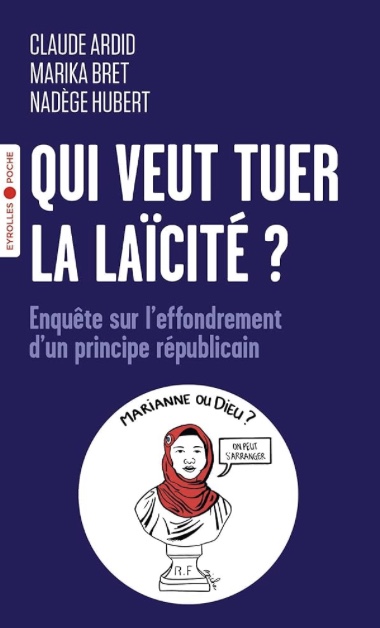
In "Qui veut tuer la laïcité", that came out in 2020, 3 journalists from Charlie Hebdo, who survived the attack on their satiric magazine adress the question. I found it particularly interesting as France lives a moment of cleavage, like most democracies, especially on the subject of how to live with a muslim community in which political islam, even though in minority, is rejecting our Western values. The authors could clearly not be associated to any extreme right or identitarian movement, which makes their enquiry objective, even though they are very troubled by the path taken and the lack of political courage to protect the French law in the context.
- "Laïcité" : definition
On the French government's official site, the subject is presented as follows :
" Secularism guarantees freedom of conscience. From this comes the freedom to manifest one's beliefs or convictions within the limits of respect for public order. Secularism implies the neutrality of the State and imposes the equality of all before the law without distinction of religion or belief."
Wikipedia will define it as follows :
Laïcité is the constitutional principle of secularism in France . Article 1 of the French Constitution is commonly interpreted as the separation of civil society and religious society. It discourages religious involvement in government affairs, especially in the determination of state policies as well as the recognition of a state religion. It also forbids government involvement in religious affairs, and especially prohibits government influence in the determination of religion, such that it includes a right to the free exercise of religion .
Secularism, emergence
"A first step was taken with the Declaration of the Rights of Man and of the Citizen in 1789, which proclaimed in article 10: “No one should be disturbed for their opinions, even religious ones, provided that their manifestation does not disturb the public order established by law. ”
Three years later, in 1792, the State proclaimed itself civil, unique and neutral. This results in civil marriage being the only valid form in the eyes of the law. The law authorizes divorce, including by mutual consent, and positions spouses equally without any religious authority being able to intervene. There also followed the appearance of republican baptism which formalized civil sponsorship, although it was not recognized by law.
The adoption of the law of 1881 put an end to the specific regime for confessional cemeteries, prohibiting not only the creation of new ones but also the enlargement of existing ones. Then that of 1887 allows you to freely choose the civil or religious nature of the funeral as well as the method of burial.
From then on, from birth to death, the morality in force and its code of “good morals” dictated by the Church can no longer impose itself in an authorian way in civil life. In the field of schooling, in 1882, Jules Ferry proposed a law for compulsory, free and secular primary education, for girls and boys aged 6 to 13. At the same time, the teaching of moral and civic education replaces that of moral and religious education.
As a result, the child is no longer a “simple” obedient and free property, but indeed a being in its own right with a major right and a priority: access to education, whatever its nature. sex and place of residence.
The emancipation of women at the same time clearly illustrates this ideal supported by secularism."
In 2004, a law prohibiting ostentatious religious signs within schools was voted to end a debate about the right for young muslim girls to wear a veil in school. The debate goes on more than ever despite the law and many school principals are giving up...
Secularism, and freedom, equality, fraternity Secularism is “freedom of conscience” and not religious freedom as too often understood. Secularism promotes equality between believers, atheists and agnostics.
Secularism reinforces fraternity , because it has abolished all hierarchy and all privilege, between people registered or not in a religious practice, that is to say... all of humanity.
Secularism focuses on individual choice, that of forming one's own convictions in full conscience and affirms the freedom to share them with others. Only secularism supports the freedom to question, to debate, in all conscience. In the field of secularism, doubt exists. In that of religion, never.
France is secular. A fundamental principle which implies that religion does not interfere in the affairs of the State. Because it is not spiritual interests which must be taken into account and guide one's action, but rather the general interest which distinguishes the individual from his confession. François Hollande: “Secularism is not a religion of the State against religions. Secularism is a set of legal rules. It is above all a principle of neutrality that the State imposes on itself, but also on citizens who must respect it. »
“Secularism is learned. It is not only a law, an institution, a reference, it is also an education. We are not born secular, we become secular. Secularism must be taught. »
Why Religions and Secularism are antinomic
"Religion involves a relationship with transcendence which can put any believer in difficulty when it locks the individual in on himself, eclipses the republican contract and extracts him from any other social relationship. Founding texts consider remarks which, when applied literally, tend to the exact opposite of what is promoted by the Republic, equality, emancipation, and even involve individual and collective drama."
Why Secularism and Islamism are so opposed
According to Wikipedia, Islamism refers to religious and political ideological movements that believe Islam should influence political systems, and generally oppose secularism . Its proponents believe Islam is innately political, and that Islam as a political system is superior to communism, liberal democracy, capitalism, and other alternatives in achieving a just, successful society.
In their book, the authors point at islamism as the main force behind our society slowing giving up on some of its values.
"The promoters, the agitators, the actors of Islamism are waging an ideological war to establish a political project giving priority to a barbaric God, deaf and blind, and who interferes everywhere, socially, economically, culturally. For Islam, this current is called Islamism and, with it, two groups, Salafism and Jihadism. Both are based on a rigid reading of the Koran from which Sharia law is extracted, the Code of “good religious practices” and the sanctions issued in the event of non-compliance with these. The passage to the terrorist act differentiates the two currents, but the first, which orders the disintegration from the French society to lead an integral Islamic life, makes possible what the second carries out.
From fear comes guilty silence or active collaboration to try to save one's skin. By quickly forgetting the program of the ideology which sows terror. Because in reality, it is this program that is terrifying. Because they are sources of temptation, women must completely hide their bodies. Because a stampede can cause bodies to brush against each other, all mixing in the street must be prohibited. Because they are won by illusion, games of chance must be banned. Because they are attributable to the Devil, all works of art must be destroyed. Because it distracts from the only authorized thought, Allah, music is prohibited. Because homosexuality is an anti-procreation deviance, perverts will end up at the stake. Those who are not faithful to the true custom among those who received the Book will have to pay the tribute of capitulation with their own hands so that they will be humiliated. Because the “Jews are rich” and are part of a Jewish-Western conspiracy, they must be wiped out.
Islamism is an attack on freedom of expression but also, and above all, a way of preventing women from flourishing, from living on the margins of their religion, their husband, their older brothers.
According to an opinion survey published in Le Point, “68% of Muslims believe that young girls should have the right to wear the veil at school”. A percentage which rises to 74% among those under 25. Forgotten the 2004 law prohibiting ostentatious religious signs within schools. As for secularism, “37% of Muslims still consider in 2019 that it was up to them to adapt to Islam and not the other way around, compared to 29% in 2011. With a peak of 49% among those under 25 years old. This same survey states that 28% of Muslims are for the establishment of Sharia law in France. The Republic, in their eyes, is only a constraint. A giant discrimination that prevents them from living the way they want."
Why are we stuck in this societal conflict?
The book cites a center-left Franch politician, Jean-Louis Borloo, who summarizes the essence of the problem :
"The churches are empty and the mosques are full. This is obviously not enough to explain the violence in contemporary societies. But when we have the feeling, particularly in France, of not having a future, we fall back on the identity that seems easiest to us to adopt: the village, the crossroads for the yellow vests, religion again for the evangelists who are also progressing all over the world. I make no value judgment. But we have created the economic, social and cultural conditions that make it possible to weaponize unnecessary radicalism ."
Another ex socialist minister, Benoit Hamon expresses it as follows :
"Look around you! What do we see? 1/ A radicalization of identity among the youngest. 2/ Anti-Semitism and Islamophobia which are increasingly gaining ground in the public space. 3/ An almost total exhaustion of the social, economic and cultural responses of the left in its entirety. 4/ An immense laziness of French intellectuals who no longer have anything to offer. We are at the beginning of the end of a world..."
The authors conclude by refering to the attack on Charlie Hebdo on January 7, 2015, where terrorists killed 12 employees and journalists and left another 11 wounded.
Freedom of expression
"Expressing an idea, contesting, denouncing does not imply any exception within the framework of our democratic rules which promote freedom of expression. All subjects without exception, whatever they may be, deserve to be brought to public attention, and can be approached in a humorous tone. This is all the more legitimate when a society sees its democratic principles threatened by a religious ideology."