The theme

The State of the World

6 articles · about 3 h of reading

In this theme

01

Baltic, the Future of Europe

Oliver Moody

34 min read
02

Cyberpunk, the New Totalitarian System

Asma Mhalla

38 min read
03

On Freedom

Timothy Snyder

37 min read
04

The Shadow Empire

Le Grand Continent

14 min read
05

End Times

Peter Turchin

14 min read
06

Choosing the Future

Nicole Gnesotto

18 min read
1 / 6

Baltic, the Future of Europe

I am happy to share excerpts and important facts and ideas from a book, that I just finished, by Oliver Moody, who is Berlin correspondent at The Times and Sunday Times, covering Germany, Scandinavia, central Europe and the Baltics. BALTIC, the Future of Europe tells us essentially about the geopolitics of the region, that could blow up to a full scale European war with Russia, if things turn badly. This is definitely not well understood by the populations of Continental European countries south of the region, nor the level of preparedness that the 8 European countries that are bordering this sea have accomplished and continue to build up. By NATO’s article 5, any military aggression on any of its member countries would be met, in return, by a military reaction. It is very comfortable to leave it to the Northern European countries, in a belief, that any aggression of the kind would never happen (just as the majority of Europeans never believed that Russia would invade Ukraine…). Accusing our leaders of warmongering because we need to reallocate budgets towards defence to create a new deterrence and show Russia Europe is serious with its will to resist any blackmail or aggression is either very naive or in my view close to treason when it comes from certain polticians. I am thinking of the extreme left (LFI) and right (RN) parties in France or Germany (AFD). Both LFI and the RN in France suggest a « non-alignment » of France, knowing how both parties have been close and even financed by Russia at times… I am very curious to see how they will respond on this topic in the coming run-up of the Presidential election that will take place in April 2027 ?

The other topic developed in the book, which is also very little known, is the level of pollution in the Baltic sea, which is a process that came from industrialisation and more recently the dumping of huge amounts of chemicals (weapons and others) in the sea after WWII by the Allies. Today, Russia is, though, the last country on its borders continuing to dump waste into it deliberately.

The book takes a look at specificities of the different countries around the Baltic sea, focused on their common priority around future security and their inspiring and supporting each other in more and more fields. I have chosen some bits and pieces, that I found particularly interesting from a continental European point of view.
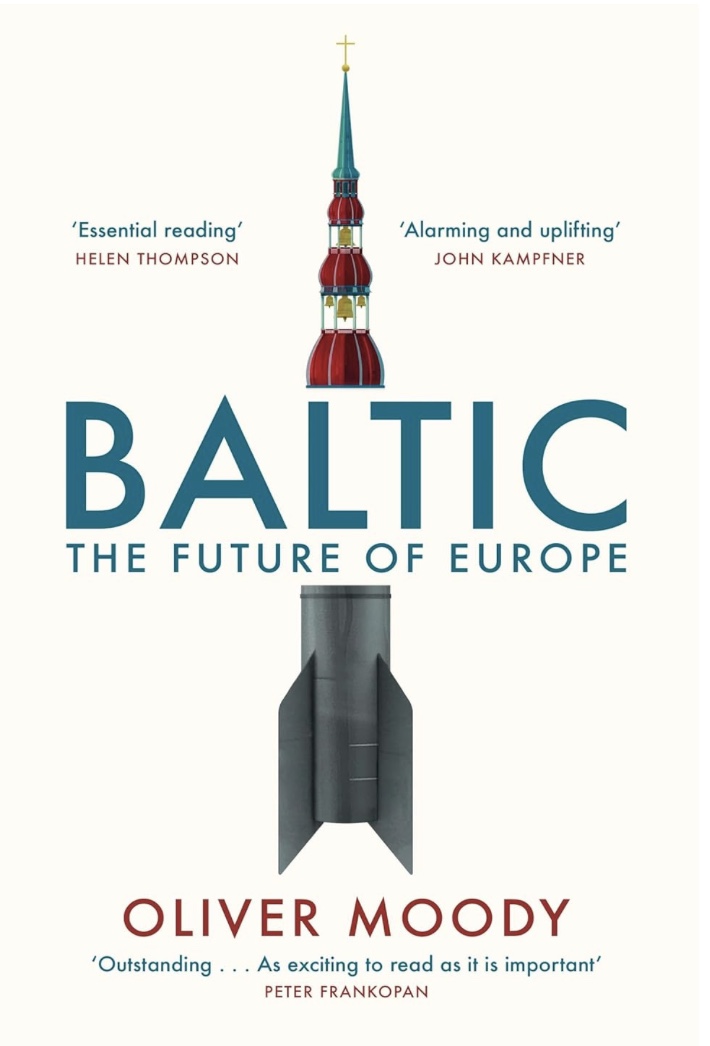
Illustration de l’article

BALTIC

The Future of Europe

The British pilosopher of international relations Christopher Coker argued a few years ago that we have collectively redefined freedom in « negative terms - not as the power to refashion the world on our terms but the right to be left alone, the right to suffer from one’s mistakes rather from the malice of others ».

Incidents of all kinds have taken place involving Nordic as well as the other countries around the Baltic sea with Russia, over the past 12 years, with an acceleration since the full-blown war started by Russia with Ukraine in 2022. These incidents are part of something much bigger : a generational contest between Russia and the West at almost every conceivable level below direct military confrontation, from energy and economics to parliaments and social networks. This contest has two fulcrums. One is Ukraine. The other is the Baltic.

All these countries in one way or another feel directly menaced by Russia, either because it looms on their borders or bombards them with aggressions that never quite rise above the threshold for military conflict. What unites them is a perception that the core values of the West are at stake and can only be preserved by the West’s standing up for them with greater conviction and commitment. If there is a way out of Europe’s current crisis of confidence and purpose, these are the countries where it will begin.

Moscow has spelt this out quite explicitly. In December 2021, as Russia built up its forces near the Ukrainian frontier in preparation of the full-scale invasion that followed three months later, Vladimir Putin’s negotiators in Washington issued a demand so fantastically extravagant that the American diplomats could scarcely believe what they were hearing. Moscow sought a legally binding undertaking from NATO that it would cease all military activity to the east of its 1997 borders.

This would effectively turn Europe’s geopolitical clock back by a quarter of a century, requiring the alliance to withdraw its forces from Poland and the Baltic states and leaving the latter excruciatingly vulnerable to Russian interference. At the same time, Sam Greene, a British Russia scholar, said the ultimatum amounted to Putin « drawing a line around the post-soviet space and planting a « Keep Out » sign. « It’s not meant to be a treaty », he added. « It’s a declaration ». « I think the Russians have been fairly transparent with what they’re seeking » says Jeffrey Mankoff, an expert on Russian foreign policy at the US National Defense University. « They want to renegotiate the settlement from the end of the Cold War ».

Putin is evidently not going to achieve this goal through diplomacy. But might he try to do it by force ? For the Europeans, it is the most important question of the 2020s.

The book is about the return of the ancient struggle with Russia for mastery of the Baltic, how the West can win it and how its outcome will be decisive for the future of Europe and the wider West. The struggle has been going on for 800 years, since two Russian principalities began extracting tribute from several Estonian statelets. Before WWI Russia controlled Finland, the Baltic states and a significant portion of Poland. Until 1989 the Soviet Union’s sphere of influence extended across the sea’s southern coast to the mouth of the German river Trave.

At times, Putin has indicated that he would like to restore as much of it as he can, through violence if necessary. As early as September 2014, reports suggested he had « privately » boasted that his armed forces could take the capitals of Poland and the Baltic states within 48 hours. In May 2024, after numerous European states said Ukraine could use the armaments they had donated to strike targets on Russian soil, he said : « Representatives of NATO countries, especially Europeans and especially representatives of small countries, should remember what they are playing with. They should remember that their countries are small and densely populated. Let them keep this in mind before they talk about attacks deep into Russia. »

His propaganda attack dogs are less coy. In 2008 Dmitry Rogozin, the Russian ambassador to NATO and future head of the country ‘s space agency, named the Baltic countries alongside Crimea and other parts of Ukraine as « traditional territory of the Russian nation ». Dmitry Medvedev, the former president who was once seen by the US as a potentially reliable partner but now spends most of his time firing off erratic social media posts, has repeatedly claimed that the Baltic states are stray provinces of Russia. For the most part, Western analysts are not inclined to take these outbursts too seriously, but the regime clearly means for them to sustain at least the impression that an attack on NATO’s Baltic flank is possible.

In early 2023, the Estonian foreign intelligence service said it believed the Russians still retained enough military resources to « exert credible military pressure in our region » and could reconstitute the units on its western borders within four years.

What is beyond dispute is that Russia has been steadily intensifying a campaign of sub-military harassement not just against the Baltic sea region but against Europe as a whole. It takes many forms : sabotage, assassinations, cyber incidents, disinformation, electronic jamming and spoofing, the suborning of politicians, and, increasingly, border provocations. It is essentially the ancient playbook of political warfare, waged with twenty first century tools on a scale that was previously impossible. The Estonian internal security service says Mosow can now «be expected to use any measures that stop short off of triggering NATO’s collective defense clause ». The Pentagon says Russia has launched a « hybrid war » against Finland since the Nordic state joined the alliance. NATO has expressed deep concern about « malign activities » against seven of its members : Poland, the Baltic states, Britain, Germany and Czechia.

It has become very important to understand the Baltic, with all its dangers, possibilities and complexities, and to develop a feeling for the historic forces that have shaped its present. This is not just because it is vulnerable. The region is far more than just the hinge of an intercontinental confrontation that only a few miscalculations could ignite into a nuclear ekpyrosis. For a Europe that often seems tired and conscious of its own relative decline, plagued by low growth and identity crises, the Baltic is also a source of ideas and optimism.
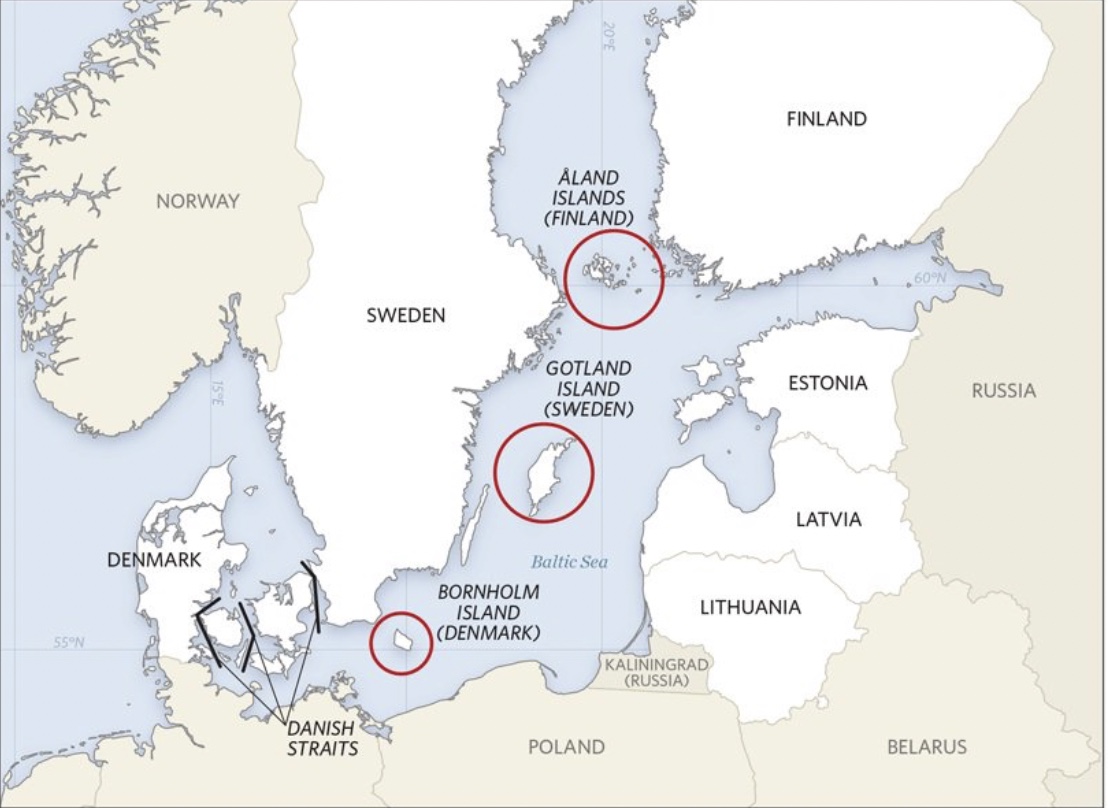
Illustration de l’article

ESTONIA :

• Education

What we can learn from Estonia is a matter of learning from an underlying mindset : a strategically calculated embrace of risk, an intense attachment to liberty, and above all the idea that a society’s defenses must be much broader that bunkers and bombs.

As in many other areas, the Estonians charged with rebuilding the education sector from scratch looked to Finland as their chief model. The guiding principle was autonomy : give pupils and teachers the motivation and the resources to work things out for themselves, and they would learn much more effectively than if the matter were simply drilled into them from on high. This process begins in the nurseries. (…) « We focus on the childrens’ skills of self-management », say Kristina Kallas, the education minister.

Once school begins, there is no segregation according to academic potential. Standardised testing is kept to a minimum, with only two rounds of national exams at the ends of the lower and upper secondary phases. The curricula tend to be fairly skeletal, prescribing « competencies », such as the ability to parse and discuss written sources, rather than textbooks or specific areas.

The OECD’s most recent PISA report, which measured 15 year old pupils maths, science and reading abilities across 81 countries in 2022, gave Estonia the highest ranking in Europe.

In its drive to harden society against the blandishments of russian disinformation, in 2024, Estonia became the first of the Baltic states to oblige schools to teach courses in « media and influencing » at upper secondary level. The national library has prepared classes on how to identify AI-generated material and a « fake news » card game called « Smarter than the trolls ». Estonia ranks fourth in the Open Society Institute Sofia’s European media literacy index, behind only Finland, Denmark and Norway.

Finally, the induction into securitized thinking starts early. As of 2023/4 school year, defence education is a compulsory school subject for all sixteen-year olds, with 35 hours of teaching spread out over two months.

• Digital Direct Democracy

Estonia has an elaborate website called Rahvaalgatus, or the Citizens‘ Initiative portal. Most western countries have some kind of system for members of the public to submit online petitions that will be debated in parliament if they secure enough support. The distinctive thing about the Estonian version is that it is married to the legally binding electronic ID cards, meaning that officials can identify more or less exactly how much genuine traction each initiative is getting. If a petition reaches thousand signatures, it must be discussed In Estonia’s parliament the Riigikogu.

The Estonians have to think about defense in the broadest possible terms because that is precisely what the enemy does. Military conflict is only one of nine different domains listed in Russia’s 2015 national security strategy, ranging from technology and finance to ecology and the interpretation of history. Moscow’s military doctine includes an explicit provision to mobilise the entire nation’s economic and spiritual resources in the event of a large scale war.

• A « Be prepared » App

This civil resilience app has a touchingly lo-fi guide to spotting misinformation. It has been developed by the Women’s voluntary Defense League and seems to be on every Estonian’s phone. Beyond recipes for cooking in a power cup, you find instructions for walking on frozen lakes, where to find the nearest bomb shelter, how to deal with bears and wolves, how to seek cover in the midst of an air strike, how to shield your windows against explosions, and an entire section on conducting non-violent resistance against an occupying power.

Estonia is a nation in a hurry. In some ways it feels as though the wider West is in a comparable situation today. It is now clear that history did not end in the 1990s but our sense of it did. If we are to seize this brief opportunity to forge a better and safer future, the best thing we can learn from Estonia is to think of time and security as interrelated and existential questions for all of us.

FINLAND

The culture of resilience is no less pervasive in Finland than it is in Estonia. But if Estonia is a country with an acute sense that time is running out, Finland is distinguished with its view of the longue durée : an ability to plan and execute grand strategy over very long periods. This ranges from foreign policy and military security to education, energy and critical resources.

We have a process by which our entire society can be switched into a different mode : the private sector, households, the public. It’s not only an ability to defend ourselves, but also the willingness of the people to do whatever it takes, says Elina Valtonen, the foreign minister.

There is much that the rest of us could learn from the country’s trajectory over the past hundred years : its adaptability, its toughness, its orientation towards the future and the underlying sober assessment of long-term challenges.

• Military preparedness

While the core strength of the Finnish defense forces consists of only 8,500 regulars and 13,000 conscripts, it can be bolstered by another 250,000 reservists in wartime. A further 900,000 or so trained civilians can be summoned for refresher courses at short notice.

The national service system remains the most comprehensive in mainland Europe, training about 22,000 conscripts, or roughly 70% of each cohort of young men, and another 18,000 reservists a year.

As early as in the 1960s, Finland began laying down layers of security throughout its society, setting out a list of priorities that included buttressing national resolve, planning for a war economy and ensuring that it had sufficient reserves to continue functioning even if the country were completely cut out from the outside world, with Switzerland as a model.

Under a programme that was introduced in the 1950s, Finland has 50,500 bomb shelters with enough space for 4,8 million people. More recently, the country has been testing its preparations for a « war economy » through measures such as ordering textile factories to switch to producing bulletproof jackets or establishing a national facility for manufacturing explosives, which are scarce across Europe. « Now every country should send the defence industry a crystal clear message that we are returning to the Cold War modus operandi in a certain sense », said Antti Häkkänen, the defense minister. « It’s about a permanent increase in the threat level ».

Since the end of the Cold War the focus has also broadened to preparedness for other kinds of crisis, such as natural disasters, pandemics, grid outages or mass influxes of immigration. The 2017 « Security strategy for society » defines a clear division of labour for government, businesses, NGOs and individual citizens to contribute to keeping the show on the road in an emergency. This is the concept of total security. « It’s not just focusing on the army or the military ; you want to make sure that society is resilient to all kinds of shocks », says Niku Mättänen, professor of macroeconomics at Helsinki University. « We have all sorts of key resources stored across the country, so that we can sustain the economy or help us overcome a very difficult winter or something like that… We also have legislation that in times of crisis allows the state to interfere very strongly in the private sector.»

• Education

This philosophy extends to the education system. Finland was the first country in Europe to introduce compulsory media literacy classes in schools, building on decades of experience. « It starts from kindergarten and then it’s part of the official curriculum, first of all to learn how to use media and how to differentiate advertising from other media content », says Anneli Ahonen, a Finnish expert on information warfare. « Then in recent years, concepts like fake news and disinformation were added there as well. »

Jyri Raitsalo, a security policy lecturer at the Finnish National Defence University, has argued that a combination, of strong education, a society with high level of trust and cohesion, and an ingrained skepticism of Russian narratives mean that the Kremlin’s disinformation campaigns have had « practically no effect in Finland ».

• Energy independence

The country takes green transition very seriously. It aims to hit net zero by 2035, earlier than any other industrialized nation. But it also requires vast amounts of electricity relative to the size of its population, largely because of the cold climate. In 2023, the average Finn used 14.8 megawatt-hours of power, twice as much as the average person in France or Germany and even a little more than the average American. Most of the sources of this electricity are comparatively clean : hydropower, nuclear, biomass, a rapidly expanding wind sector and imports from Sweden. The country aims to generate significantly more electricity than it consumes by the end of the decade.

Finland has been alive to the geopolitical changes that we witness much earlier than most of its European peers. « We have to see that the world is changing, and not in a good way. We are seeing that with the United States, China, Russia, there are more geopolitical tensions there », former President Sanna Marin said in 2021 already. « So we should have our own capacity to produce the necessities that we will need in the future, and for our societies today… If you are dependent, then you are fragile. » As a result, the country has embarked on a drive to establish a grip of its own over critical raw materials and especially over the essential ingredients for batteries, such as copper, nickel, lithium, cobalt and vanadium. It has poured billions of euros into its mines and set up dozens of facilities for refining, processing and recycling battery chemicals.

Finland is also beginning to move into the production of rare-earth metals. In 2023 prospectors discovered the world’s largest deposit of carbonatite, a kind of rock that tends to be rich in strategic minerals, at the Sokli mining reserve in Lapland. Months later, the country became the first in the EU to resume the extraction of its own uranium, which had previously been discarded as an unwanted by-product at the giant Talivaara nickel mine in central Finland.

DENMARK

• The poison lake

At the end of WWII the Allies dumped about 42,000 tonnes of mustard-gas shells and other chemical weapons into the Baltic, mostly off the coasts of Bornholm and Gotland. Unoficially, the practice continued into the 1980s. There are also about 160,000 mines and possibly another 200,000 tonnes of bombs, torpedoes and conventional artillery shells. Studies suggest the casing of about half of these munitions has by now rotted away, allowing their contents to leach into the surrounding sea. Some of these chemicals have started turning up in fish, prawns and lobsters. The risk to human health has yet to be fully assessed, as has the cost-benefit balance of going through the astronomical expense or retrieving what is by now essentially a slurry of corroded metal and sediment from depths of more than 80 metres.

The munitions may brag the attention but purely in terms of scale they are dwarfed by the vast array of other contaminants that more than a century of shipping, heavy industry, metropolitan sewage and littering have strewn over the Baltic. After the Nord Stream pipeline bombings scientists modeled the « toxic plume » of dangerous substances the blasts might have stirred from the seabed. There were 28 on the list and only half of them were chemical weapons. In fact, the researchers concluded, the chemical munitions had probably accounted for only à 0,1% or so of the toxicity. By far the biggest contributor was TBT, a family of pesticidal compounds that used to be painted on to the hulls of ships but were banned in 2008, followed by lead, copper and caesium-137, a radioactive isotope largely deposited in the aftermath of the Chernobyl disaster.

The polluants sometimes interact with one another in invidious ways. One example is the Baltic’s unexpectedly high concentration of thallium, an intesely poisonous metal released as a by-product of cement manufacturing. The sea contains what one researcher recently called « the geographically most extensive area of thallium contamination ever documented ». For the time being, much of the thallium is effectively locked away by the hypoxic dead zones, which prevent organisms from recycling it into the food chain. If these zones are reoxygenated, however, there is a risk that the thallium will come back into play.

The effects are compounded by global warming. Since 1980 the Baltic has been heating up faster than any other coastal sea in the world. Depending on the course of global carbone emissions, most forecasts suggest the sea temperatures will increase by 2° to 4° by the end of the century.

The upshot is what ecologists call « regime shifts ». Some species such as the sprat and the pikeperch, are doing nicely. The round goby, an invasive fish thought to have hitched a ride from the Black sea or the Caspian in a ship’s ballast water, is spreading along the Southern Baltic coast at a rate of about 20 miles a year. The blue-green algae have spread tenfold since detailed records began. (…) Some infectious pathogens are thriving. One study found that the number of cases of vibriosis, an infection caused by a seaborne bacterium and frequently resulting in diarrhoea, rises around the Baltic by as much as 200% especially in warm years.

The map of biodiversity metrics complied by HELCOM, the Baltic’s intergovernmental conservation group, is awash with red. Only four of the 24 measures for the Borholm basin are judged to be satisfactory.

It is easy to get sucked in by the apocalyptic undertow that pervades environmental commentary. The situation is bad. But that is all the reason to concentrate on our agency and ability to turn things around.

Across the wider Baltic, many initiatives have wrestled the level of nutrient pollution flowing into the sea back down to levels last seen in the 1960s, with each country assigned a limit to the tonnage of nitrogen and phosphorus it can dump. There is still a long way to go, and given the slow rate at which the water circulates, the easures have yet to make any discernable difference to the bonfire of eutrophication. But it is at least a start.

Increasingly, the states are simply resorting to prohibition. Some harmful chemicals, such as pesticide DDET and the Carcinogenic PCB family of compounds, have been almost entirely eliminated from the Baltic through international bans. Since 2023, it has been illegal for passenger ships to discharge human sewage into the sea. A year later, Denmark became the first country in Europe to impose a blanket ban on « scrubber water », the toxic fluids left over after a ship’s exhaust pipes have been rinsed with sea water. There are already sporadic signs that these measures are cumulatively beginning to work. Conservationists in particular have had a few successes. The white-tailed eagle, which was practically extinct in the Baltic half a century ago, has now recovered around the Gulf of Botnia to the point where its predations are becoming a nuisance for eider ducks and reindeer. The Atlantic sturgeon, which was once wiped out in the region, has recently returned to Finnish waters, etc…

While Russia only accounts for a small fraction of the total Baltic coastline, its ecological footprint on the sea is dire. It continues to dump all types of waste into the sea. The average Russian discards 59 kg of plastic waste every year, compared to 12,7 kg for the average Dane and 29,3 kg for the average Swede, and about 14% of this rubbish winds up in the rivers. As a result, the country is estimated to leak as much as 15,000 tonnes of plastic into the Baltic annually, more than any other littoral state. It operates a « ghost fleet » of at least 400 tankers to circumvent western oil sanctions that have cut off access to credit and insurance, as well as another 2,000 smaller vessels. The tankers are thought to carry about half of Russia’s seaborne oil exports, the economic mainstay of the country’s war machine. Many of the ships are old, dilapidated, uninsured and staffed with crews who have little knowledge of the Baltic’s treacherous maritime geography. They are, in other words, an environmental calamity waiting to happen.

They are also a serious security concern. Many of the ships are equipped with antennae and other sensors that could be used to conduct military reconnaissance and intercept communications. Senior commanders in the Swedish military have suggested they could be used in a crisis to block up a port or to land a cargo of troops and armored vehicles on a target such as Gotland.

• Energy

The forests of wind turbines sprouting off Bornhom are also the vanguard of a concerted push towards clean energy. In 2022, the leaders of the 8 EU member states around the Baltic declared an ambition to install 19,6 Gigawatt of offshore wind power – about seven times the current capacity – by the end of the decade. Sweden alone plans to build a 5,5 GW cluster of wind farms, capable of providing enough electricity for 5 million households, around the island of Gotland.

Denmark and Estonia both plan to generate 100% of their electricity through renewables by 2030, while Lithuania is aiming for 90% and Germany 80%. A consortium of forty energy firms from 8 Baltic sea region countries hopes to establish Europe’s first regional green hydrogen network of any significant size, producing 100,000 tonnes of gaz a year. Sweden, Finland and Poland intend to build new nuclear power stations, and the Baltic states, after thirty years of bickering, may finally build reactors of their own.

THE BALTIC COUNTRIES’ SUPPORT TO UKRAINE

Denmark has offered its entire inventory of artillery to Ukraine, joined forces with the Netherlands to set up a coalition to donate F-16 combat jets to Kyiv and set out a proposal for the creation of an EU cyber-defense « brigade ». Sweden was the first European country to shut down its Confucius institutes and « classrooms », ; tools of Chinese state influence in the guise of cultural exchange. Estonia initiated the ammunition procurement drive for Kyiv and publicly contemplated putting troops on the ground in Ukraine for training or air defense. Latvia, which had counted Russia among its five top import and export partners before 2022, has debated whether to sever these trade ties altogether with a blanket embargo. In early 2024 the presidents of Latvia and Estonia made a joint appeal to their NATO allies to consider following the example of the frontline states and bring back conscription.

When Anthony Blinken, the US secretary of state, told the foregin ministers of the Baltic states that they were « leading the way » in NATO, it was more than just a condescending pat on the back. It was a recognition that they have been the activist wing of the transatlantic alliance. The three countries, often acting in concert with their neighbours, have lobbied Brussels to confiscate frozen Russian assets and senators in Washington to release a 60 billion$ package of weapons for the Ukrainian armed forces.

They have consistently urged their western allies to be bolder and more creative in resisting Russian pressure and don’t allow themselves to be so intimated by Moscow‘s efforts at nuclear blackmail. « We need to understand that Putin is a gambler and all the threats he makes are not because he’s strong but because he feels weak » say Gitanas Nauseda, the Lithuanian president.

Speaking in march 2022, Joe Biden said that the « Ukrainians’ brave resistance » was « part of a larger fight for democratic principles that unite all free people : the rule of law, free and fair elections, the freedom to speak, to write and to assemble, the freedom to worship as one chooses and freedom of the press. The West has to steer itself for the « long fight ahead ».

RUSSIA AND THE BALTICS

Through the eyes of the Russian regime, we are already at « war », even if the shooting phase has not begun yet and may never begin. It’s not a question of « Will there be a war ? There is a war » says Krisjanis Karins, Latvia’s foreign minister and foreign prime minister. It’s a question of « Will we do enough to make sure that this war does not spread in Europe ? ». « The main objective of this phase is « controlled chaos », a state where our decision-making, both as states and societies, is hampered by doubts and uncertainties ».

• Disinformation

Russia’s efforts to sow lies, foment mistrust and suborn the democratic processes across the West have been exhaustively documented, to the point where their reach and efficacy are sometimes overstated. Giving Moscow too much credit for our generally poor standards of informational hygiene not only over-eggs Russia’s hold on our populations but also distracts attention from how many of these problems are home-grown.

The countries around the Baltic have had more experience with these techniques than any other part of the West. « Disinformation is like Covid », a senior minister from one of the Baltic states says. « After a while, you build up immunity. You get better at recognising it every time ». But that is not quite the whole truth. While there is some evidence that media literacy is improving in the frontline countries, a significant minority of people are still susceptible to Russian narratives. One found thet up to a tenth of Lithuania’s population was « living in a Russian disinformation field ».

• Border provocations

These range from routine incursions by military units to periods in which the Russian and Belarusian regimes encourage migrants from north Africa, the Middle-East and south Asia to fly into their territory and then funnel them towards the borders of the EU.

Russian combat jets and, less frequently, naval vessels have been toying with NATO territory for more than a decade.

There has been consternation at Russia’s periodic flirtations with physically tweaking its western frontiers. In May 2024 its defence ministry issued a draft decree that suggested it might unilaterally revise its maritime borders around several tiny islands in the eastern gulf of Finland, and between Kaliningrad and the Lithuanian part of the Curonian spit. The document was swiftly withdrawn without explanation but set nerves jangling as far away as the Åland islands between Finland and Sweden, which had been occupied by Russia during tye Napoleon wars and coveted by the USSR in the 1930s and 1940s.

• Physical violence

The final gernus of hybrid activity is outright violence, against both things and people. The most extreme cases have been murders and assassination plots, including an apparently speculative plan to try and kill Volodymyr Zelendsky at an airport in Poland, and a hammer attack on the Russian opposition activist Leonid Volkov in Vilnius. The notable thing about both cases, which came to light in the same week of April 2024, is that Russian and Belarus operatives alledgedly recruited Polish citizens to carry out the dirty work rather than doing it themselves. At the same time, according to Supo, the Finnish main domestic security agency, the Russians no longer care about getting caught.

• Advantages over NATO

Lieutnant General Jürgen-Joachim Von Sandrart, the commander of NATO’s multinational corps north-east, says that Russia has five significant advantages over NATO in the Baltic.

o The first is geography. Moscow has an abundance of possible lines of communication and can cut off the aliance’s sole land route into the Baltic states by taking the Suwalki gap.

o The second is that the Kremlin, as the putative aggressor, would decide « when, how, where and why » to start a conflict. Given Russia’s proficiency at exploiting the blurry boundaries between war and peace, the 32 allies may not agree that an invasion has begun which demands a military response until it is too late to salvage the territory that has already been lost.

o The third is the Russian disregard for life. The West is acutely sensitive to casualties, especially when civilians die. We should be proud that we care so much. But this care does also result iin a certain aversion to risk. Russia, on the other hand, has deliberately killed thousands of Ukrainian non-combattants and proven willing to expend tens of thousands of its own poorly trained and equipped troops on « meat-grinder » offensives.

o The fourth advantage is logistics. « Russia’s infrastructure for the rapid deployment of forces over roads, railways and the air from any part of its geography to its border is ready ».

o The fifth and final advantage is Russia’s unity of command and effort. It is a single country whose assets can at least in theory be wholly subordinated to the war effort. Power is hugely centralised under the general staff at its national defense control centre in Moscow, which encompasses 49 government agencies, from the police to infrastructure and economic management. « It is one nation, one regime, one nomenklatura, one autocratic leadership system, from politicians to the military, going all the way through horizontally and vertically », Sadrart says.

Finally, for NATO, there is the huge question of « interoperabilty », the military jargon for getting various national forces to work together as an effective whole. As an example, the military alliance has at least 14 kinds of 155 mm artillery shells…

NATO’S PREPARATION FOR THE BALTIC COUNTRIES

The basic mechanics, starting with land warfare are :

o A first line of defense with troops on the ground in the frontline states, supported by a total of 15,000 to 20,000 forward-deployed US and NATO multinational personnel.

o Then comes the Very High Readiness Joint Task Force, about 20,000 strong, with a « spearhead » brigade of roughly 5,000 soldiers who can theoretically be dispatched within two or three days.

o This is followed by 2 more multinational « initial follow-on » brigades, or another 10,000 soldiers.

o Overall, the idea is to have 30 battalions (approximately 30,000 soldiers), 30 air squadrons and 30 warships in the conflict zone within 30 days : the so-called « 4x30 » principle.

o Under the new NATO force model, however, the ambition is to have « well over » 100,000 troops ready to go at ten days’ notice, rising to 300,000 at ‘high readiness », which seems yo mean anything from a fourtnight to a couple of months.

« If that is implemented, then Ithink that we have more than enough conventional capability to convince Russia that they cannot win any fight or take any part of NATO in 72 hours and not face armed resistance », says Professor Peter Viggo Jakobsen et the Royal Danish Defense College.

• The worst scenario

According to Tomas Ries, a senior lecturer in security and strategy at Sweden’s national defence college :

The scenario that is most alarming is that Putin would invade one or more of the Baltic states with conventional forces, but at the same time he would put both his European and global nuclear forces on full alert and would tell us that if we get involved, if we support the Baltic states, then he is ready to use nuclear forces.

NATO is not ready for that. It’s not capable of dealing with a situation like that. I can say that categorically, because I was working on it for about six years with NATO during the Cold War. I know what it takes to develop a nuclear deterrent, and we don’t have any of that now. Zero.

• Europe’s preparedness

What matters just as much as the money that the Eurtopean Union is preparing to pour into military preparation, is the underlying mindset. Beyond the frontline states, most European leaders have not yet candidly told their populations how much is at stake and the extent to which ensuring their safety will require sacrifices from us all. Some of these sacrifices are financial, such as higher taxes, cuts to other areas of public spending or the « security premium » on the prices of many goods that come with attempts to reduce dependencies in our supply chains. Others are inconveniences, such as additional bureaucracy or the periodic allocation of civilian transport to military exercises.

Yet the hardest and most fundamental thing we will have to give up is the psychological comfort we have become used to. Security is not a thing to be restored ; it is a thing to be created. There is no going back to the innocence of the 1990s. Baltic sea countries such as Finland, Estonia and Sweden have been preparing their publics for every kind of prospective crisis : where to shelter from a rain of missiles, how to cope with sustained power cuts or internet outages, how to survive if you are forced to flee your home and seek refuge in the woods.

It is not pleasant to live in a mental world full of risks and dangers. In many of us there is an innate impulse to switch off the news and turn away, or to assume that these precautions are all very sensible for the Estonians but have nothing to do with us. Humankind, as the bird says in T.S. Eliot’s Four Quarter, « cannot bear very much reality ». But the countries of the Baltic have already grasped what the rest of us urgently need to understand : in the end it comes down to a straightforward choice. We can face up to these possible futures and calmly prepare ourselves to make the best of them. Or we can blank them out and then suffer the consequences.

CONCLUSION(S)

One of the core arguments of this book is that the states around the Baltic have been forced in various ways to develop precisely the kind of bold and deep resilience for which other western countries are currently fumbling. The other is that they are emerging as a new power centre in their own right.

The question is how Europe as a whole can benefit from that power and resilience at a moment when it has lost its bearings and when its perspective on the future has narrowed to a defensive angst, plagued by fears of both relative and absolute decline. Its share of global GDP has fallen from 20,2 to 14,3% over the past 25 years. (…) Europe is a long way behind the US and China on critical technologies such as quantum computing, AI, and batteries. It is in danger of losing parts of its high-tech industry to rival regions with lower energy prices and more lavish subsidy regimes.

The demographic trends are also alarming. Europe’s total population probably started shrinking in 2024. Its workforce certainly did. Many of its governments have tried to plug the gaps by importing labour from the outside world. Combined with the heavy influx of illegal immigration over the past decade, that has resulted in the highest level of population turnover countries such as Germany and Sweden have experienced in centuries. Both factors have produced a politics in which anxieties about change and the loss of control and status predominate. Many European leaders have expressed worries about the health of democracy on the continent.

Most importantly, the arrival of full-scale war on their borders and the possibility of being abandoned by the US have also produced a sense of impotence and learned helplessness.

None of the countries around the Baltic sea is immune to these effects. Their politics, too, are influenced by pessimism, wariness of immigration and squabbles over scarce economic resources. They do not have complete answers to any of these problems. But they do provide at least some starting points and countervailing tendencies.

The frontline states of the Baltic understand that there can be no stable modus vivendi with a state that is seeking to re-establish a sphere of influence over our allies and is prepared to use violence to achieve it. That is why their leaders maintain that the only viable strategy against this Russian regime is what Kaja Kallas calls « smart containment » : unwavering support for Ukraine, the long-term maintenance of sanctions, the prosecution of war crimes, and a collective military capacity that could credibly defend NATO territory at its easternmost borders. There is no way back to business as usual or the world we think we knew.

Alexander Stubb, the Finnish president, has warned his peers against using « belligerent » rethoric and argued that the West should pay more attention to Russia’s fundamentally weak position. In his view, we should fret less and do more. « What I call on all Europeans states to do is to become more Finnish. In other words, more prepared », Stubb said shortly after taking office. « You have to prepare for the worst in order to avoid it ».

Since the Soviets were significantly weaker than the West as a whole, « the latter’s success will really depend on the degree of cohesion, firmness and vigour which the western world can muster. And this is a factor which is within our power to influence. » That is truer today than it was 8 years ago. Western unity is not an end in itself. It is the means by which these countries assert themselves and regain the upper hand in this contest without fighting. And this depends not only on strength of arms but on the will to use that strength as leverage.

It has become fashionable for western European leaders to say they should have listened to the countries of the Baltic sooner. Yet, we are not listening hard enough. It is no longer just a question of heeding the warnings that were ignored. It is a matter or recognising that they are the West’s geopolitical avant-garde. In an increasingly dangerous and unpredictable world, they have not only grasped that everything we have built is at risk unless it can be secured. They have also articulated and realized a positive vision of how to put the West back on the front foot, and a compelling idea of what Europe could be : more hopeful, more assertive in defense of its values and interests, more conscious of solidarity with other liberal democracies, more open to the potential of technology, more confident of its own distinctive strengths, less constrained by fear. In the dark years ahead we will need a future to aspire to. The Baltic is the factory of that future.
2 / 6

Cyberpunk, the New Totalitarian System

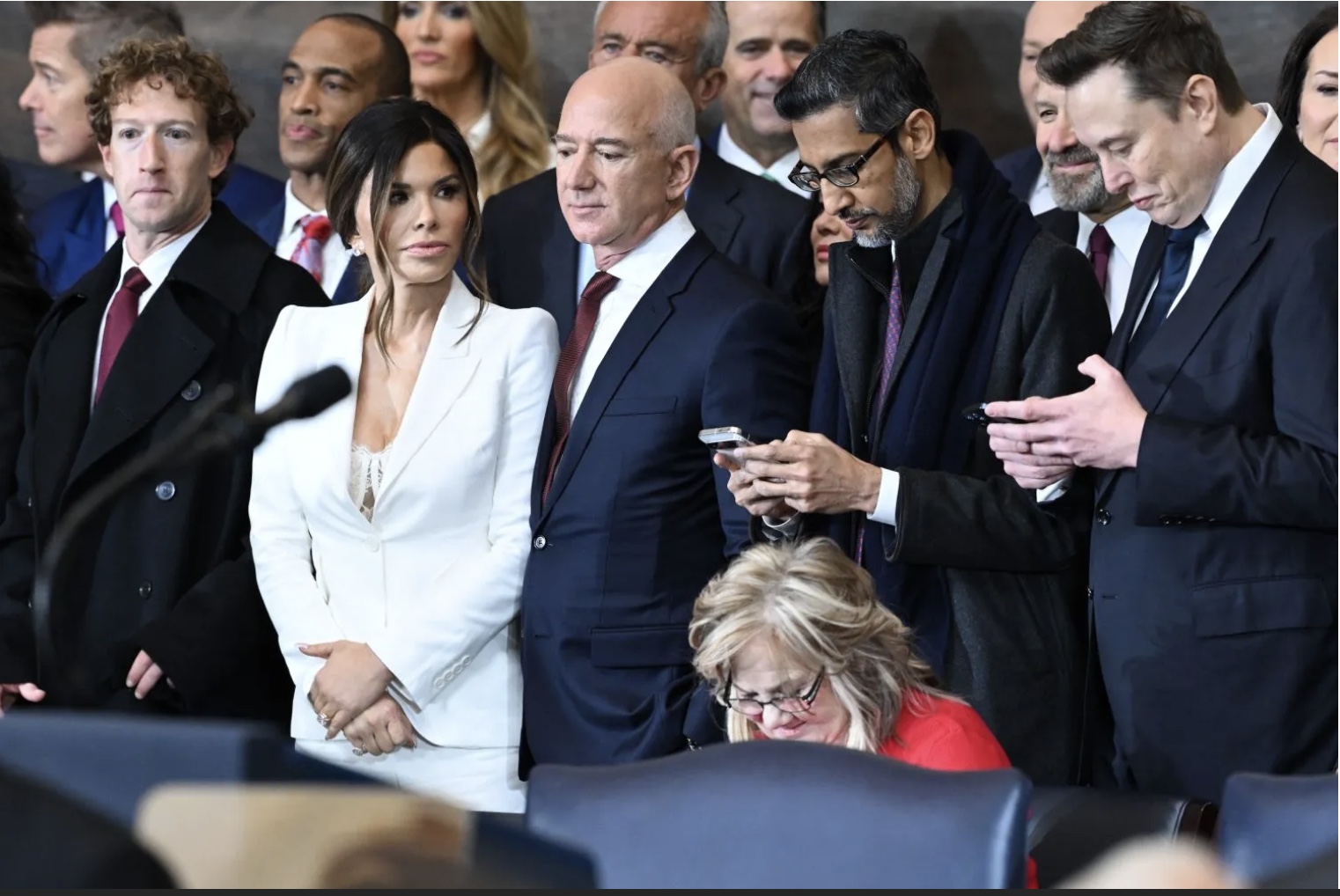
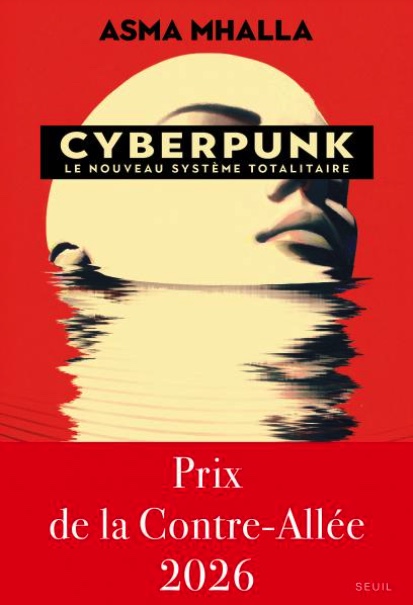
In the essay I summarize below (in a shorter version) and in the "Major Themes" section (in a longer version), we return to one of the major themes of our time (and of this blog): the risks facing our democracies, and in particular American democracy right now. The alliance between a less and less creeping authoritarianism and the power of mega-corporations is creating a rapidly accelerating space-time continuum.

In this new essay, imbued with the urgency of our times, Asma Mhalla, a French-Tunisian political scientist and essayist specializing in technological public policy, attempts to account for the speed of the world's transformation. This work, with its aim of clarifying and raising awareness, also reminds us that possibilities for resistance exist if we are willing to change our ways of thinking.

It is a fascinating essay, that I've just read twice... Enjoy!

Illustration de l’article

CYBERPUNK, The New Totalitarian System,

by Asma Mhalla

APRIL 2026

“When you doubt yourself, keep this in mind : this century doesn’t forbid you from thinking ; it occupies you until you no longer know how.

The only remaining singularity is that of standing firm inwardly. A fragile path that will be ours to transform the grip of power.”

THE QUESTION

The alliance between a techno-reactionary fringe and a demagogic and authoritarian billionaire paints the shadow of a possible 21st-century (techno)fascism.

In the past, fascism was born of ailing, more or less democratic, political and economic systems. It manifested itself in organized movements for the conquest of power, which established regimes based, in particular, on the myth of the providential leader before collapsing in the roar of bombs.

In the new century, the problem is now plural: while political leaders, whether fascist or not, or just a little bit so, follow one another and resemble each other, interchangeable even in their frenetic madness, techno-political units are systemic. When a few technologists with profoundly anti-democratic sympathies insert themselves directly into the democratic process, when they are not dependent on any election, any popular legitimacy, when they are nevertheless the new pillars of our economic, (geo)political, and social system, this does not simply signal the possibility of a threat; it is already a problem. Their unbridled power is beyond our control. Our legal system is struggling, but it is weak. Civic consciousness, exhausted by the magnitude of the Herculean tasks ahead, is only just beginning to emerge. Meanwhile, some of these units pursue a predetermined ideological agenda, brooking no contradiction.

THE CYBERPUNK DYSTOPIA IS HERE

The future is behind us.

In the turbulent moments of history, we often realize the shifts and upheavals too late. We don't always grasp the distance between our era and its understanding of itself. Let's establish once and for all that the future, whether feared or hoped for, is not a prospect yet to come. The evidence is unfolding before our eyes: dystopia is not a projection ; it is all around us. We live in the world we once feared with fascination.

"The future is already here," declared William Gibson, one of the leading authors of the science-fiction literary movement known as cyberpunk.

This trend reveals typical elements: the technological iron cage is omnipresent, framing an overpopulated, over-polluted world where disillusioned and isolated individuals wander in disenchanted megacities ruled by ultra-centralized power, monopolized by megacorporations, decadent states, and techno-surveillance with invisible claws that manipulate both minds and bodies, in the fusion of humans and machines.

For our time, the equation to solve is techno-political in nature. It revolves around the Big Tech-Big State alliance. The Big State is an imperial state that derives much of its power from and thanks to technological giants. For now, apart from the United States and China, few states can claim this status. It is worth noting that only the Big States have managed to cultivate Big Tech companies that have become hybrid and systemic actors. As the possibilities for projecting technological power, and therefore domination, increase, the threats to freedoms worsen in the same proportions of scale and speed. The new techno-political paradigm encounters little resistance: our technologies, our lives, and our imaginations were already primed to accommodate it.

Look around you. Don't you have the vague feeling that you're experiencing a moment of collective dissociation? We sense that the systems are collapsing, yet we carry on as if nothing were wrong.

Urban hypermodernity, a world in multi-crisis mode, the hyper-presence of interfaces, the unregulated power of Big Tech, control technologies normalized in the name of security, a feeling of loneliness, cognitive overload…

RETROFUTURISM

Our relationship to time, or more fundamentally, our capacity to think about our time, was disrupted with Trump's return to power, this time with Elon Musk in his wake. They were moving faster than our capacity to theorize the present, a present that, as it was being created, was becoming a historical turning point. Hyperspeed and shockwaves prevented thought from settling, and resistance from organizing itself. (…) Our contemporary difficulty in theorizing what is happening to us in real time stems from the fact that we are in a breach of history. We find ourselves suspended between past and future, between the nationalism of the 1930s, the conservative values ​​of the 1950s, and the prospective projection of a new, augmented civilization under cognitive control. A curious retro-futurism, marked by the powerful slogan “Make America Great Again,” which promises the return of a mythical golden age of the past while compulsively working to accelerate chaos, made possible by hyper-technologies, in order to impose a new order. A schizophrenia of the system, which is malfunctioning without any safety mechanism at hand.

Theorized in the late 1990s by British philosopher Nick Land at the University of Warwick within the Cybernetic Culture Research Unit (CCRU), accelerationism emerged as a critical postmodern movement.

At the turn of the millennium, Nick Land took a neo-reactionary turn, embracing a virulent critique of equality and democracy. The acceleration of capitalism and technology was intended to create the chaos conducive to the establishment of a techno-authoritarian order. Nick Land proposed several ideas that would become central to Silicon Valley ideologues: a return to hierarchy, technocracy, and private governance, with the state to be managed like a business (hence the obsession with efficiency, which directly inspired DOGE's roadmap), and an absolute capitalism where hyper-technologies and the economy must operate without moral or democratic constraints. Land's accelerationism soon became intertwined with that of the far right, and with the National Socialist Liberation Front, the American neo-Nazi party, which had been talking about acceleration since the 1980s. But here, the target was no longer capitalism but liberal and multicultural society. The goal was to accelerate chaos to provoke a racial civil war and impose white supremacy, and more specifically, that of white males (women being merely expected to perpetuate the species). These are all ideas that have been seized upon by certain far-right blogger-ideologues, including the highly influential Curtis Yarvin, a close associate of JD Vance. The main points of this can be found in the infamous Project 2025 (which we already discussed in February 2025, Mikael's note…), this 922-page document written by the very conservative Heritage Foundation, Donald Trump's programmatic toolbox.

We could say that what Land imagined, Yarvin conceptualized, and Musk implemented. The cyberpunk dystopia is well underway, but we still don't know where it will lead, or when…

A WALTZ IN THREE-STEP

We are in transit between two worlds. To grasp the shift in state that concerns us, let's take a generous fifteen-year step back. The first imbalance introduced into the system's stability could be traced back to 2008, the year of the subprime mortgage crisis. The second was called Covid-19, and the third took root in 2014 in Ukraine. Fifteen years and three major crises, all of which were, according to the same political methods, never resolved, merely neutralized.

It is in this context of general chaos (…) that the old world was plunged into the void and that the decay accelerated. From January 20, 2017, the date of his first inauguration, Donald Trump gave a voice and a face to the energy of emptiness. From then on, the unraveling of American democracy would unfold in three stages.

Three raw ruptures that, by extension, dragged Europe into them.

Phase 1 – The Trump I Era, late 2016–2021 : the era of “ Post-Truth Politics .” The concept of post-truth coincided with the massive spread of social media, tools for information, disinformation, interference, and cyber-hybrid destabilization, as well as for political and diplomatic communication. “Post-truth” became the norm. It was not a question of censorship in the traditional sense, but rather of an (algorithmic) reorientation of attention, playing not on terror but on desire and subliminal manipulation. Of this initial breakthrough, the Cambridge Analytica scandal became the definitive symbol: the personal data of 90 million Facebook users worldwide was stolen and used to influence the Republican vote in the United States and the Brexit vote in the United Kingdom in 2016. There was no need to spread propaganda through fear; social networks amplified the winner's narrative with an economy of means unprecedented in the modern history of anti-democratic movements. From 2016 onward, facts no longer mattered; they could even be "alternative," according to Trump I. Through the sheer force of social media's attentional regime, one regime of truth could replace another in just a few months. The erasure of facts, the fog of attention, not only created a new regime of truth but a new regime of reality. Confrontation with reality became almost impossible. Reality was disappearing; this was our first shift.

Phase 2 – Trump II Era, 2025, ongoing : the era of “ Post-law politics .” Enveloped in the manipulative techniques of post-truth, America embarked further on the deconstruction of its democratic foundations in the name of fighting the “ deep state ,” the “ woke ,” the establishment , and the bureaucracy. While the promise of bureaucratic streamlining is not aberrant from a strictly public policy perspective, the method suddenly morphed into a witch hunt: “streamlining bureaucracy” meant dismantling the checks and balances of the constitutional framework. The United States was entering the era of unashamed post-legalism. (…)

Phase 3 – Post-Trump Era: “Post-State Politics .” Trumpism places no importance on the concept of democracy, which it readily appropriates as a rhetorical weapon to discredit its domestic political opponents or weaken its European allies, perceived as too dependent and too weak. The word “democracy”—instrumentalized against Europeans by the unbridled spread of the most violent reactionary ideologies (which they summarize as “freedom of expression”), in fact designates, within the American power structure, another, more brutal reality: the reshaping of the very concept of the state. We maintained a naive and artificial distinction between political power and technological might; it has now vanished. Only two types of hyperpower remain: the "unitary executive," an old American conservative fantasy revived in its maximalist version in Project 2025, which grants the president free rein, and algorithmic power. Both serve a new theory of the state, minimal in its architecture, total in its capacity for control.

THE MONARCHY OF THE CRAZY

Two names obsess Silicon Valley : Peter Thiel and Curtis Yarvin, architects of the neo-reactionary thinking from the West, commonly known by the acronym NRx. Let's call this small techno-reactionary group the B-NRx Brotherhood.

Thiel, founder of PayPal and Palantir, controls Founders Fund, which finances Anduril, SpaceX, and Rumble. A self-proclaimed libertarian-reactionary and disciple of René Girard, he instrumentalizes mimetic violence to justify vertical power. His thinking also draws on Ayn Rand and Leo Strauss. In 2004, in "The Straussian Moment," he described a decadent West. In 2009, in "The Education of a Libertarian," he advocated for a departure from politics through technology: cyberspace, outer space, oceans. He concluded: "a deadly race between politics and technology." In 2020, at the Hoover Institution, he reduced Europe's future to three options : Sharia law, totalitarian AI, or radical ecology. In 2014, he published "Zero to One," an ode to monopolies. After supporting Trump in 2016, then breaking with him, he launched J.D. Vance. Vance's rise sealed the Thiel-Trump reconciliation.

Curtis Yarvin (aka Mencius Moldburg), a blogger and computer scientist, theorizes a monarchical regime led by an enlightened Chief Executive Officer (CEO). His "Cathedral" refers to the progressive infiltration of institutions. His proposal, RAGE (Retire All Government Employees), which is also found in Project 2025, aims to purge the civil service. Yarvin draws inspiration from the Scottish philosopher Thomas Carlyle, an elitist and racist, and from Nick Land. His "Dark Enlightenment" rejects the legacy of the Enlightenment, except in a very diluted form.

The B-NRx embodies an elite in revolt, tired of having to compromise with the common people. Thiel says it best : democracy is the enemy of his  freedom. In this two-tiered world, the elite becomes a caste. The others—the middle class, immigrants, and "deviants"—become a Fourth World. Musk, obsessed with birth rates and Mars, dreams of a sorted humanity. Like the Russian cosmists he mentions, he fantasizes about immortality. Their revolt targets the bourgeois elites, the press, and the people. Thiel speaks of a "tyranny of the mediocre." Their elitism is crushing us. A split has emerged: the technocratic elite against everyone else. The elites are seceding.

AMERICAN DREAM : THE END OF THE WEST ?

Donald Trump’s return to the helm of the world’s leading power signals the end of political liberalism. With the rhetoric of the enemy, little stands in the way of neo-fascist discourse: neither our unraveling social bonds, nor our entrenched isolation, nor our atomized lives. From the campaign onward, the MAGA/F-NRx alliance set about creating “objective” enemies, encouraging everyone to gradually see the enemy in their neighbor. These strategies of distrust and internal division pit citizens against one another in a quasi-insurrectionary atmosphere, chaos remaining the invariably effective recipe for authoritarian regimes seizing power.

The world’s leading power is returning to a world where the law of the strongest—in reality, the richest—prevails, turning away from the very foundations of Western values. It would seem that they are becoming something else, governed by different rules and different borders.

For the moment, the American ideal is no longer freedom but efficiency, posing this political question : is empire compatible with democracy? Democracy rests on the principle of political equality, while an empire rests on the asymmetry of status—center versus periphery, citizens versus subjects.

America and China are playing two variations on the same theme to determine which of the two will be the architect of the new world order:

• Expansionism, unilateralism, and transactionalism define the new triptych of international relations. Trade warfare allows for the systematic control of one's immediate spheres of influence. In parallel, American expansionism in the pursuit of resources is asserting itself openly: from the fantasy of buying Greenland to the strategic interest in Ukrainian rare earth elements, conquest is achieved through geological predation;

• The return of industry as a lever of power. The new world order will not be one of software or soft power, but one of technological hyper-industries. The United States is actively relocating critical supply chains—semiconductors, batteries, defense infrastructure—and reactivating a proactive industrial policy. At the heart of this new industrial revolution, the hard engineers of power are conquering techno-industrial ecosystems that are re-anchoring capitalism in matter, energy, and machines.

The cyberpunk post-Western is a world where engineers have replaced thinkers, where the empire is rebuilding itself with algorithms, hypersonic weapons, and rare earth mines. Facing China, the new America flexes its muscles : the return of steel, rockets, and oil—high-tech capitalism is once again conquering, colonial, and voracious. The logic of power is self-referential; it now aims solely at its own reproduction, settling into a dynamic of perpetual, technical, and performative surpassing. In this sense, Trump and Musk embody two mirror images of the post-political "next frontier." Two sides of the same desire for expansion, with no other horizon than the transgression of limits. While the aesthetics are not yet cyberpunk, its civilizational promise certainly is: the "new frontier" is also retro-futuristic: terrestrial for the real estate magnate, galactic for the space entrepreneur.

THE ORPHANED CONTINENT

Faced with the disintegration of a civilization whose very foundation it once nurtured, will Europe remain a source of sustenance or a dissenting voice?

The Old Continent suffers not so much from a lack of resources as from a lack of direction. Faced with the new techno-political order, it positions itself neither as an adversary nor as an alternative. For, as it turns out, Europe no longer knows what it is. Being a follower of the United States means not only being behind the times, but also being incapable of formulating a discourse on the world. The problem is that it is primarily burdened by itself. It has not lost power ; it has delegated it to its systems: committees, frameworks, budgets, directives. It is no longer a question of absent sovereignty, but of absurdity. By constantly trying to avoid offending anyone, Europe has programmed its own impotence. She confuses prudence with lucidity, consensus with strategy, and still believes that by multiplying rules she will eventually exist in the global algorithmic chaos.

• Mikael's note : As this book was published in September 2025, I think some time has passed and Europe has begun to find answers—if not clear and unified—to the world's chaos, at least more coherent ones, with its most important members (including the UK) increasingly aligned on most issues and on how to project unity.

Paradoxically, it is perhaps in its relative marginalization that Europe can forge a geopolitical alternative. No longer considered a strategic partner, the European Union has the opportunity to reorient its alliances toward other middle powers, united not by the same asymmetrical relationship with America. Canada, India, or certain African states, also under pressure, could become the linchpins of a pragmatic and cooperative diplomacy, more flexible, but rooted in a logic of rebalancing. A realignment of geopolitical solidarities would allow Europe to regain influence. She won't succeed alone, but by building relationships. After all, the very notion of power is founded on the idea of ​​a balance of power between nations.

But the situation is urgent because information infrastructure is now mostly American. The progressive camp, stuck in the 20th century, is still handing out gold stars and demerits. It could have reclaimed what it abandoned: freedom, not as a slogan, but as the power to act; solidarity, not as a moral high ground, but as a strategic lever for forging a new social contract in line with the challenges of our time. It's simply a matter of reopening the space for what is conceivable. The European far right, for its part, faces a dilemma: serve an America that despises it or dissolve itself by breaking free.

Ultimately, Europe will only regain its power if it takes back control of the issue. What do we want to be? For whom and for what do we want to remain free ?

The European project is not obsolete. It is orphaned. It needs a face, a narrative, a break with the past. No longer a Europe of mere norms, but a Europe of life, meaning, and memory. Otherwise, it will remain a map without a story, a territory without a destiny.

DUAL-ENTRY FASCISM

Original fascism is a flexible and authoritarian ideology, nationalist and anti-liberal, advocating a strong state and the suppression of opposition. Tailor-made for mass democracies in crisis, it took on varied, non-linear forms.

Fascism is not a fixed doctrine, but a pivotal ideology, with a xenophobic, racist, conservative, nationalist, and corporatist DNA, coupled with adaptable, opportunistic practices.

In August 2024, Trump evokes a “zombie apocalypse” of immigrants and promises “the largest deportation in history.” On April 2nd, he called them "animals." On September 18th : "They come from the Congo... from Asia... and are destroying the fabric of life..." On October 5th, he spoke of "poison in the blood." He talked about racial purity, about "blood" as destiny. This is how fascination works : hammering home an idea until it becomes commonplace, whitewashing it in the media, imposing it as fact.

Trump's disregard for the truth is a hallmark. Musk follows the same logic: limitless action, with no regard for facts. What matters is building the dreamed-of future. They manipulate impulses, designate scapegoats, centralize power, and act without truth. Paxton recalls what the revolutionary philosopher Georges Sorel wrote, for whom there is no such thing as a conservative ideal : fascism is reactionary, traditionalist, bigoted, and victim-centered. Trumpism is based on a feeling of injustice : America is supposedly paying for everyone.

Fascism transposed to Trump : hostility to democracy, a weak but growing cult of personality, arbitrary centralization, expansion of executive power, propaganda, alliances with Javier Milei or Vladimir Putin, and imperialist fantasies. Three traits of fascism resonate with our times :

• A confusion of party and state . Arendt wrote: “At every level, the administrative machine of the Third Reich was subject to a curious duplication of services.” Project 2025 proposes to “dismantle the administrative state” and replace it with loyalists. Self-management = a masked purge.

• A fascination with technology . Hitler and Mussolini loved speed, machines, and industrial warfare. Part of the spirit of fascism. Filippo Tommaso Marinetti, theorist of the Futurist movement, who never hid his support for the Mussolini regime from the 1920s onward, glorified speed, war, militarism, contempt for women, and the destruction of libraries. A techno-aesthetic vision of violent domination that could today be endorsed, word for word, by the accelerationists of Silicon Valley.

• A virility  historically fueled by the return of humiliated soldiers from the Great War. Today, it's an economic, social, and existential masculinity. Mosse describes the Nazi woman as passive, a mother race. We find this in the misogyny of the MAGA apparatchiks or Musk's neo-natalism. Contemporary fascism is not a replica. It is post-ideological. It performs fascism on three levels: form (slogans, clashes, symbolic purification), structure (unitary state, weakening of checks and balances, appointments), and ecosystem (think tanks, influencers, X/Twitter, and Alt-Tech platforms). However, it does not (yet?) have a single party, nor centralized physical terror.

This neo-fascism is a two-pronged genetic mutation, simultaneously postmodern and hypermodern, reactionary and futuristic, solid and fluid, which I will summarize by quoting George L. Mosse on the völkisch aesthetic of Nazism: “The most advanced technology was integrated into an ideology that looked to the past to determine the future.”

A WANDERING CIVILIZATION

Since the crises of capitalism are cyclical, fascism, too, can only be recurrent, as a response to crisis. But which crisis was decisive for today’s?

We endlessly replay the same play. A sick economic and political system, a crisis of corrective actions to maintain stability, then promises, always the same until they become inaudible. And so on… Viewed from this perspective, that of derailment, fascism can also be considered a resistance to the dominant narrative that it claims to destroy through its counter-discourse. A resistance to Western rationality, elevated to the status of a religion, to the disenchantment of the values ​​it once embodied. A resistance as artificial as what it claims to criticize.

Anger stems from the unfulfilled promises of progress, from that awful feeling of never being in control of oneself, of being nothing more than the custodians of vague, adrift, and meaningless existences, lives that don't matter because we are constantly told they do.

Fascism is never the dominant narrative but presents itself first and foremost as a counter-narrative, feeding on the labored breathing of a political and informational system that is suffocating itself. Its meteoric rise comes from this. It breaks the monotony, rails against "decadence," and channels the anger of millions of people who cry out their need to exist. Understood from this angle, Trumpism is not a rupture but the paroxysmal point of a political model, called liberal democracy, imperfect by nature, failing in times of crisis, sick from the consensus it believes it embodies without alternative.

What this new fascism does best is understand and caricature the system that created it. Donald Trump lies for the sake of lying, inflates figures for the sake of inflating them, uses one word for another without any real meaning. For example, why did Trump repeatedly claim that US military aid to Ukraine amounted to $350 billion rather than $180 billion (the actual figure)? The lie is merely a performance, almost a whim, of omnipotence, and its very enormity, by preventing us from responding, is a way of conditioning us to arbitrariness.

THE SHOW OF SIMULACROUS FASCISM

Fascism doesn't pretend. It does not simulate arbitrary dismissals, the suppression of science, the politicization of the state apparatus, the delegitimization of the judiciary or the press, the persecution of political opponents, arbitrary arrests, the brutality of migrant deportations, or nepotism. Naked reality is still there, material, brutal, and alive. It is buried, but never completely destroyed. Just buried under a layer of staged events, which rarely offer any rational justification (tariffs, hatred of others, etc.). Reality will only be accessible to all after the catastrophe, when the scaffolding of these simulacra can no longer hold.

It recycles the language elements of original fascism (the national-sovereignist axis, traditionalist values, the invocation of a fantasized, idealized past, the atmosphere of crisis and the sense of urgency in the face of the specter of "decadence", fascist codes and aesthetics). Playing on symbols that are both fascist and Nazi is enough (the posture of the "tough guy", the gang leader, the rhythmic and brutal nature of the words and postures, the shouts, the Nazi salutes...).

Postmodern fascism is inherently technological. In its element, it can amplify at will the blurring of the lines between "true" and "false" in a generalized fog of information and attention. Images, narratives, and simulacra become more real than reality itself. This simulacrum-fascism has no need to be based on proven reality or even on facts. Its flawed ideology, its internal contradictions, and its infighting are part of its very essence. Its lack of direction guarantees its plasticity; it can say and do whatever it wants, depending on the context, without being constrained by any ideological backbone.

Fascism rests on a simulacrum of power. It presents itself as a revolutionary ideology, but it reenacts old forms of domination. Trumpian simulacrum-fascism pushes this aesthetic to its extreme. Trump himself comes from reality television. He replicates in the White House what shaped him: the artifacts of scripted television sets with their interchangeable backdrops. The Oval Office or the bubble of the TV studio, it's all the same. Ease comes naturally because we operate precisely within a hyper-reality constructed by and for simulacra. To act or to pretend, what difference does it make, since we all participate in this game, we all pretend to adhere to it, to fear it, or to reject it, but in any case, to believe in it? The simulacrum-fascism of Trumpism could not exist without all of us, without the voracious media system and its avid public, constantly validating it, even under the guise of analysis and criticism—and I tremble as I write this, afraid of being caught in the same trap as everyone else.

It's not so much that the United States is no longer a democracy, but rather the more interesting idea that being or not being a democracy is no longer important. At the moment of its rise to power, postmodern fascism is an authoritarianism without dictatorship. There's no need for camps or any kind of secret police ; it's enough for people to believe in the regime's omnipotence for them to obey and self-censor. Similarly, it would be pointless to abolish elections or the press; it's enough for these institutions to exist as inoperative simulacra to give the illusion of choice. Symbolic repression or actual roundups of migrants also become a spectacle. The media tribunal of a few persecuted scapegoats, presented as examples, is enough to create fear, without the need for a true purge in the Stalinist sense of the term. This is not an illiberal democracy, but something else entirely: a regime where citizens believe they are living under the yoke of a fascist power, where there are only symbols of fascism… but strangely, these symbols are just as effective and performative as an actual fascist organization.

MASS TECHNOLOGIES

We cannot establish a strict parallel between the new century and the previous one for one major reason: the technological foundation and informational infrastructures are radically different. The scales and scopes are, a priori, incomparable.

Contemporary far-right movements were among the first to understand the extraordinary opportunity that hyper-technology, particularly social networks, could represent. Their simple ideas, alternately conspiratorial and/or anti-establishment, spread extremely quickly. In France, as early as the late 1990s, well before other parties, the National Front created its website, an unparalleled medium for bypassing traditional media and speaking directly to the people.

Contrary to popular belief, social networks primarily operate vertically, from top to bottom: from the leader, or influencer, to their base ; then horizontally, spreading throughout the base. In these new circuits of emotional engagement, the role of investigative journalism becomes marginalized, not due to a loss of quality, but because attention shifts elsewhere, faster, more intensely, and to a deeper level. This virtual mobilization is emotional and grows with angry clicks. It is distributed between meta-platforms and small, maximalist exchange spaces of Alt-Tech (Gab, Discord, Rumble, Odyssey, Telegram, etc.), and is facilitated by pseudonymity and immediacy, which makes abuses (cyberbullying, defamation, insults, proselytizing, etc.) impossible to contain in real time.

Hyper-technologies can be diverted from their initial purpose with disconcerting ease, to the point of creating a mind control worthy of Orwell's 1984. Ideological propaganda would become an internal psychological war, punctuated by the compulsive clicking of our comfort sensors. If one of the principles of fascism is the control of the intimate—from private life to thoughts—then hyper-technologies, in the hands of a few fanatical technologists coupled with ill-informed leaders, risk plunging us into the void of cognitive totalitarianism. In terms of controlling the intimate and the mind, this drift will soon seem archaic and ludicrous when we enter the realm of consciousness with brain-computer interfaces (BCIs). This implant will be supposed to decode intention. Tomorrow, it could interfere with our thoughts, our memory, our reflexes, our knowledge.

PERVERSE WORDS

“ War is peace.”

“Freedom is slavery.”

“Ignorance is power.”  In Orwell’s 1984, the Party’s three slogans were emblazoned in capital letters on the facade of the Ministry of Truth. A perfect manipulation technique.

Words too visible, words too invisible, and still others that contradict each other. When words disappear or are twisted, ideas die with them. Language thus brutalized contributes to the explosion of the individual. How can we name things, how can we speak of what is happening to us when definitions are annihilated and their connection to shared reality is no longer agreed upon ? How can we avoid abdicating our thinking when our raw material, language, suddenly fails us ?

Read the executive order signed by Trump on March 27, 2025, intended to “restore truth and reason to American history.” Its goal : to reconstruct the national narrative by banning all mention of slavery, colonization and the eradication of Native Americans, racial segregation, and the cultural diversity of the United States, in opposition to a supposedly dominant “revisionism” that leads to a “sense of national shame.” Its primary target: the Smithsonian Museum in Washington, an institution founded in 1846 that encompasses some twenty museums of American art and history, libraries, and educational centers. To complete this undertaking of rewriting—and erasing—memory, the Trump administration quickly moved to also curtail academic and scientific freedom. The executive order dismantling the Department of Education is a symbolic example. On Fox News, White House Deputy Chief of Staff Stephen Miller presented it as the necessary response to the “Marxist bureaucrats” who were encouraging anti-white racism. The Purge obsessively criminalized the use of words and phrases related to gender identity or the fight against discrimination (DEI). Hundreds of words like "immigrants," "inequality," "disability," "Black," "trauma," "social justice," "discrimination," "racism," "woman," "minority," "climate change," "pollution," etc., are now banned in administrative language and scientific research projects. The administration abruptly halted funding to major universities like Harvard and Columbia, stopped research on climate and, more generally, on sustainability science. Entire databases disappeared. Through a series of ill-timed executive orders, the executive branch of this new America has relentlessly suppressed the rights of the most vulnerable American citizens while claiming to protect them. More words, but this time to disguise the betrayal of the people, the brutality of the injustice.

Orwell's 1984 illustrates the cognitive mechanism employed by contemporary fascist powers. The Orwellian "Ministry of Truth" uses an official language, "Newspeak," to shape reality : imposing a description of events while denying objective reality, ultimately undermining individuals' confidence in their own memory and judgment. The goal is to create a regime of single thought where all dissent is rendered unthinkable by eroding the individual's capacity to perceive and understand reality independently. "Doublethink" is a crucial concept for maintaining the Party's power. It refers to the ability to simultaneously believe two opposing viewpoints and accept both. Doublethink involves being aware of reality while, in good faith, adopting the lies that contradict it. It's knowing something is true while simultaneously asserting the opposite. "Doublethink" uses logic against logic. It allows one to use logic to justify illogical ideas, to refute morality while claiming to uphold it. It involves forgetting facts that have become inconvenient, remembering them again when they become useful, and then forgetting them once more. It suspends any principle of non-contradiction, and therefore all critical thinking. In Orwell's world, if the Party claims that two plus two equals five, "doublethink" allows one to believe it... while knowing it's false.

After acquiring X/Twitter, Elon Musk presented the platform as a bastion of absolute free speech, while simultaneously taking the opposite approach. The more radicalized he became in real time, the more what he called "free speech" amounted to increased censorship of certain targeted content. He claimed to defend a "free" platform, but X/Twitter suspended investigative journalists critical of his management. In doublethink, this translates to : "To protect free speech, you have to silence those who use it against me." Musk justified the removal of the platform's old moderation policies in the name of freedom, while simultaneously establishing opaque algorithmic control that favors his own tweets and those of his political allies. In doublethink, this means: "A neutral algorithm favors those I choose." By removing safeguards against online hate, Musk has facilitated the spread of far-right, even openly pro-Nazi, rhetoric, while surreptitiously shadow-banning the accounts of Democratic or progressive activists. In doublethink, this means: "Let everyone speak except those who bother me." Freedom of expression, a fundamental right in our states governed by the rule of law, is itself becoming an ideological charade. Musk is not defending freedom of expression ; he is producing a concept emptied of its original meaning, turning it into a tool of power. This reversal of meaning makes any criticism difficult, because the debate is trapped in a logic where "freedom" becomes a justification for control.

“Freedom of expression” has come to mean that moderation is censorship, that insult and abuse are a fundamental right… While digital raids organized by online militias have been busy silencing all criticism of linguistic abuse and lies.

(We could continue the Orwellian analogy, but our world is no longer Orwellian; it’s the aftermath. Language is frozen in protocols to recode reality, but emptied of its critical capacity.)

POLITICAL GASLIGHTING

As if to find a rational explanation for our intellectual inability to grasp the complexity of the new world, everyone has started endlessly sharing their feeling of “astonishment.” Behind this effect of astonishment, the new attentional regime is taking shape: saturation as a new political expression of censorship.

The sham fascism draws inspiration from the phenomenon of "gaslighting," a type of psychological manipulation that reverses the burden of proof between perpetrator and victim, oppressor and oppressed, strong and weak: if the weak complains of violence or inconsistency on the part of the strong, it is they who are wrong, who are actually the persecutor, or even who are insane. Political gaslighting makes the target doubt their own perception of reality, their memory, or their judgment. The postmodern fascist leader deliberately pushes their people to distrust the institutions they are supposed to uphold, as stable points of reference (and especially as checks and balances such as the judiciary and an independent press). Arendt described these techniques ahead of her time :

“The result of a consistent and total substitution of lies for factual truth is not that lies will now be accepted as truth, nor that truth will be defamed as falsehood, but that the sense by which we orient ourselves in the real world—and the category of truth relative to falsehood is among the mental means to this end—is destroyed.”

Arendt distinguished between two types of truth: factual truths (what actually happened, history, concrete facts) and rational truths (logical and philosophical principles). Fascism invents a third type of truth: irrational truths. Perverse truths.

Thus, fascism does not describe reality ; it produces it through its pronouncements. It does not prove its pronouncements; it orders reality.

The heart of the performative lie is an assertion repeated until it becomes experienced as true, not through its factuality, but through its social and symbolic effect.

What is said becomes true, not because it is verified, but because it is internalized. It imposes an alternative regime of reality. It does not merely dominate a social or political space; it reconfigures the very perception of the world. It erases contradictions, rewrites the past, sabotages science and disqualifies knowledge, and reverses the burden of proof. It fragments society into secondary conflicts, presented as ideological, to the point of preventing any space for discussion from forming, each person entrenched in their own mental trench. It doesn't refute reality ; it replaces it. It eliminates institutions that produce competing truths, destabilizes the benchmarks of shared knowledge, and transforms the public sphere into a continuous receptacle of equivalent statements. Lies become the equal of facts.

This methodical obfuscation relies on widespread confusion : images, narratives, accusations, scandals, proclamations… Everything is leveled, narrated as equivalent. In this controlled chaos, democracy can no longer guarantee the existence of a shared truth. This simulacrum of fascism empties language of its grounding in reality, which it subjects to the narrative of power.

A TAKEOVER ON THE STATE

We are witnessing a hypermodern update of Hobbes's Leviathan, a two-headed creature, a dual and hybrid Big State and Big Tech, a Dileviathan .

With Trump and Musk, politics was replaced by two capitalist entities, a businessman and a technologist, whose main shared characteristic was to translate the slightest complexity of the world into a whim or a transactional equation.

The new Leviathan's feat is dizzying because of its childlike simplicity. Post-truth politics has already blurred our relationship to reality. In doing so, it has facilitated the shift to the second stage, which the author calls post-law politics, which seeks to create confusion in our relationship to the rule of law, a condition for trust in politics, in other words, for the liberal democratic model. This system was certainly not perfect, but it at least allowed for demands to be made, for inequalities and injustices to be rectified, for issues to be discussed at some point, for certain struggles to be brought to light, and for others to be fought. Winning was not guaranteed, but the right to exist was guaranteed. We find ourselves at the heart of this second phase.

Upon taking power, the DOGE (Democratic Office of Government Affairs) prioritized everything the Dileviathan had abhorred: agencies fighting disinformation, such as the Global Engagement Center (now permanently closed); development aid worldwide, and incidentally, tools of American soft power like USAID; education; research; pensions; social assistance; and certain healthcare services targeting the most vulnerable Americans. In contrast, federal contracts between the defense sector and its long-standing subcontractors remained virtually untouched. By paralyzing their activities or dismantling their offices, the DOGE neutralized without much resistance entities that could have positioned themselves as a counter-power, such as the National Labor Relations Board (NLRB), which until then had been in open conflict with SpaceX and Tesla, or the Consumer Financial Protection Bureau (CFPB).

With access to data being the beating heart of new powers, the DOGE (Department of State and Government) forced access to some of the most sensitive US Treasury computer systems, including information on bank accounts and Social Security, disregarding the necessary security clearances. These systems are now vulnerable to insecurity and arbitrary use. There was, of course, legal repercussions. But to little avail. In March 2025, under the guise of modernization, the Trump administration began building an infrastructure for the total control of citizens. At the heart of the system : the megacorporation Palantir, tools for mass data sorting, and the merging of dispersed sensitive data. A slide toward an invisible, technical, and potentially repressive power.

MINIMAL STATE, TOTAL STATE

A violent spasm, hypermodern fascism is transitory, a fast track to the next technopolitical era, that of "post-state politics," the third stage of the genetic mutation of our democracies. Metacapitalism has pulled off a masterstroke: it's not just the systematic destruction or subjugation of democratic checks and balances (the courts, Congress, the free press, etc.), a practice that has become commonplace under many more or less liberal regimes; it (finally) eliminates all political power. At the helm of the leading capitalist power, two capitalists enrich themselves, preside, redirect power to their own advantage, manipulate it according to their ideology, automate, reduce, liquefy, and mechanize the state apparatus, which has become a mere technological pyramid. A Leviathan with elusive hyperpower, disseminated throughout the infinite array of coded matrices. The government of people is replaced by a corporatized governance, supposedly pragmatic, detached from democratic aspirations. Massive deregulation and the politicization of the state apparatus contribute to the privatization of political power for the benefit of a few strategic private actors.

The history of collusion between politics and economic power is not new, even in democracies. In the 19th century, the new industrial class worked to establish a bourgeois moral and political order that favored business. At the beginning of the 20th century, figures like J.P. Morgan and Rockefeller wielded similar influence. It was therefore predictable that tech giants would follow this dynamic. The difference lies in the scale of power. They are no longer private actors but system actors, owners of vital infrastructure, geostrategic bottlenecks across all layers of cyberspace, collectors of some of the most sensitive data, and they partly shape the nature and tone of our public debates and our access to information on a global scale. The minimal state is not merely authoritarian or semi-privatized; it is technological. When Elon Musk began his campaign to purge the federal government, he played with ID numbers, lines of code, and figures, not with real lives. This transforms the rule of law, conceived, built, and regulated by and for human justice, into a cold, disembodied fiction.

COGNITIVE TOTALITARIAN SITUATION

The emergence of neurocapitalism  has posed an unprecedented political question: the end of the very concept of freedom, or rather, free will. And no serious answer has been offered. We were grappling with the only true rupture: the end of bodily integrity and, with it, the very death of the concept of freedom.

The mechanisms of cognitive totalitarianism are already in place. Saturation: orchestrating constant distraction, preventing any possibility of independent thought, any critical distance, and even any hope. Artificial intelligence systems: predicting and modeling preferences, desires, and choices before they even reach consciousness. Algorithms: adjusting behaviors to maintain the social and market  order, rendering any form of rebellion ineffective. Virtual reality: manipulating perceptions through filters, fabricating images and narratives with artificial intelligence. As in The Matrix , we can become, and in part already are, extensions of the social machine.

Technological transformation is redefining the structuring verbs of our regimes of subjectivity. Thinking, for example, used to be an active process: doubting, formulating, branching off. Today, it's clicking. AI takes over the intellectual effort; it sorts, prioritizes, recommends, makes certain narratives visible, and renders other knowledge invisible. The thinking subject is atrophied. It no longer elaborates; it consumes ready-made content. The smartphone is not a tool. It is a portal that draws us into the subjectivity of those who created it.

THE FLESH OF THE WORLD

A new fundamental freedom will soon take center stage: cognitive freedom. In other words, the right to think for oneself, to preserve the integrity of one's mind, to refuse the colonization of one's neurons. To claim this freedom is to perform an act of inner sovereignty. It is to make free thought a fundamental right, a new dignity to be protected.

But to claim this freedom is already to go against the grain. For in a world that moves too fast, thinking becomes an almost subversive act. A solitary act, therefore agonizing. Another name for the malaise of the century is "solitude," the kind that makes one lose touch with oneself, the world, others, their flesh, their matter, their humanity. A desire to fight back. A rejection of science. A silence saturated by noise. The desperate emptiness of one's own condition will feed on "alternative truths." The emptiness, once it becomes the norm, then culture, becomes brutalization. First, the brutalization of speech. Then came the realm of impulses, of lone wolves, of acting out. Privatized democracies, producing a world without subject or responsibility. The ethics of self, the condition of our humanity, collapses.

Faced with the weakening of institutional checks and balances, a response nevertheless takes shape. From Trump's first term, the New York Times decided to embody the face of the fourth power: journalism. A vital foundation of democratic functioning: providing access to factual information. Despite pressure, intimidation, and attempts to gag the press, a segment of the print media, through its integrity, still upholds the honor of its profession. Journalistic work is the first line of resistance: investigating, demanding accountability, refusing to yield to threats. Judges and universities have followed suit. Justice, information, science: three pillars of democracy.

When the narrative falters, the stakes of information transcend the simple distinction between true and false. It becomes the foundation of stability for society.

BELOVED FREEDOM

We should all proudly uphold our fundamental freedoms:

• The right to live as we see fit without our private spaces being invaded;

• The right to think freely, without weighing our words in fear;

• The right to express ourselves freely, without fear of censorship or harassment;

• The right to move about, to demonstrate, to claim public space without the fear of being watched, spied on, tracked, caught, or interrogated;

• The right to enjoy our bodies without being ostracized.

Political freedom is the choice to be or not to be, to believe or not to believe.

The only possible antibody, the only available survival guide, lies in a discipline of curiosity, a resistance to fatigue and indifference.

MAPPING THE DILEVIATHAN

Four Mutations of Power

Like any living system, the Dileviathan mutates, replicates, and branches off.

Here are four possible scenarios for a power that no longer needs a tyrant. These scenarios are not fiction. They are variations of the present, already gestating before our very eyes.

Each figure has its own world. Each mutation has its own protocol.

Exploring these trajectories is a vital exercise for being prepared for the unpredictable.

• Scenario 1: The Authoritarian Merger

Vortex

Figure: Big Leviathan

Dominant Pole: Big State and Big Tech have merged their capabilities; the Dileviathan becomes an unbridled Leviathan.

The State and the platforms are now one.

Power is vertical, algorithmic, and militarized. AI governs in place of law. You are free—as long as you comply.

• Scenario 2: The   Crack

Internal Fracture

Figure: The Empire Splitter

Dominant Pole: None—the two heads are misaligned.

Big Tech and Big Tech are out of sync.

Conflicts of interest, desynchronization, ruptures. The Dileviathan cracks. Faults open, and the breaches become political.

• Scenario 3: The Free Archipelagos

Distributed Dissidence

Figure: The Hacker-Communard

Dominant Pole: Decentralized resistance against a weakened Big Tech

Zones of digital autonomy emerge

Dissident collectives organize, code, and reinvent. Central power loses ground in the margins.

• Scenario 4: The Exhausted Monster

Slow Implosion

Figure: The Zombie Techno-Bureaucrat

Dominant Pole: A Leviathan that has become obese and inefficient

The system collapses from within .

Too many layers, too many standards, too many bugs. The Dileviathan suffocates in its own complexity.

The Age of Repair

A great battle has been lost. Let us not return to the old world. Let us build the narrative of the next. A narrative of repair, not restoration.

A great responsibility awaits us: to invent a new political age founded not on nostalgia, but on utility. Here are some of its main outlines:

• Return of the Common Good

What is vital must be protected from predatory practices.

Water, Energy, Sensitive Data, Healthcare, Knowledge.

And the law, which must be restored, to establish new freedoms, new boundaries.

• A Century of Repair

Acknowledge the damage. The mistakes and errors, too.

Then repair together: the bond, the living, memory, justice, education, health.

This will not be a favor. It is the bare political minimum.

• A New Civic Age

Move beyond political management.

The people are not a statistical mass. And they are not at the spectacle (and what a spectacle it is!) but in the agora that belongs to them.

They inform themselves. They arbitrate. They govern.

Intellectual sovereignty. Political sovereignty. Economic sovereignty. Technological sovereignty.

Life sovereignty. Rights sovereignty. Freedom sovereignty.

3 / 6

On Freedom

FREEDOM is probably one of the most common themes in litterature and philosophy. More recently, Western democracies have defined it as one of an individual's essential rights, starting with the French Revolution's "Liberté, Égalité, Fraternité", confirmed by UN's Declaration of Human Rights and anchored by Rooseevelt and Churchill's agreement, in 1945, on the "Four Fundamental Freedoms ", ie Freedom of Expression, Freedom of Confession, Freedom from Fear, Freedom from Want...

Freedom goes hand in hand with Democracy, which is the reason why it is just as threatened by the present authoritarian trends, particularly in the United States. But what is happening on the other side of the Atlantic could very well spread if the populist movements in Western Europe gain power.

That is why I've found this book so interesting. Timothy Snyder is an American historian at Yale University, specialized in Eastern Europe's and Russia's history, and has now recently moved to Canada. You have already met him in this blog, with several interviews and articles.

His book "On Freedom" is recent, as it was first published in October 25.

As "Goodreads" puts it :

"Timothy Snyder has been called “the leading interpreter of our dark times.” As a historian, he has given us startling reinterpretations of political collapse and mass killing. As a public intellectual, he has turned that knowledge toward counsel and prediction, working against authoritarianism here and abroad. His book "On Tyranny" has inspired millions around the world to fight for freedom. Now, in this tour de force of political philosophy, he helps us see exactly what we’re fighting for.

Freedom is the great American commitment, but as Snyder argues, we have lost sight of what it means—and this is leading us into crisis. Too many of us look at freedom as the absence of state We think we're free if we can do and say as we please, and protect ourselves from government overreach. But true freedom isn’t so much freedom from as freedom to—the freedom to thrive, to take risks for futures we choose by working together. Freedom is the value that makes all other values possible.

"On Freedom" takes us on a thrilling intellectual journey. Drawing on the work of philosophers and political dissidents, conversations with contemporary thinkers, and his own experiences coming of age in a time of American exceptionalism, Snyder identifies the practices and attitudes—the habits of mind—that will allow us to design a government in which we and future generations can flourish. We come to appreciate the importance of traditions (championed by the right) but also the role of institutions (the purview of the left). Intimate yet ambitious, this book helps forge a new consensus rooted in a politics of abundance, generosity, and grace."

I've tried to extract the most significant messages in the summary, that you will find in the "State of the World" part of our main themes or through the link below.

Why I have put it under "the State of the World" segment instead of "Philosophy", is because I believe that our generation and our childrens', in the West, are facing severe threats to Freedom for the first time in our lives, making this a highly timely subject.

Starting with his own experience and discussions with ukrainians on their notion and definition of freedom, Timothy Snyder then compares Positive to Negative Freedom, thereby defining freedom and introducing the five forms of liberty, that he claims link freedolm as a princiople to freedom in practice. The five forms are Sovereignty, Unpredictabilty, Mobility, Factuality and Solidarity and a each one is dedicated a part if the book. Within these parts, the author examines subjects such as Social networks and predictability, Truth and Freedom, Liberty of the press, Lies, Oligarchs, Libertarianism, "Free markets"... We then extract main ideas on Freedom and Democracy, before concluding with Freedom in the US, which, even though it has always had a different history and meaning, has seen more recent and stunning developments, that could well impact other democratic societies. Enjoy!

ON FREEDOM

by Timothy Snyder

February 2026

Illustration de l’article

"I went to Ukraine during the war while writing this book about freedom. The subject is a sensitive one everywhere there. A month after the Russian invasion of Ukraine, I spoke with Ukrainian lawmakers: “We chose freedom by not fleeing.” “We are fighting for freedom.” “Freedom itself is a choice.”

This isn’t just about politicians. In war-torn Ukraine, speaking to soldiers, widows and widowers, farmers, activists, and journalists, I constantly heard the word “freedom.” The way it’s used is interesting. With much of their country under genocidal occupation, Ukrainians might have good reason to speak of freedom as liberation from, or the absence of, evil. They do nothing of the sort.

When asked what they meant by freedom, none of my interlocutors specified that they were liberated from the Russians. A Ukrainian man told me: "When we talk about freedom, we don't mean 'to free oneself from something'”. Another defined victory as being " for something, not against it." The occupiers had hindered the feeling that the world was opening up, that the next generation would have a better life, that the decisions made now would have a significant effect in the years to come.

It was essential to eliminate repression, to acquire what philosophers call "negative liberty." But disengagement, the elimination of prejudice, was only a necessary condition for liberty, not liberty itself. According to a soldier in a rehabilitation center, liberty meant allowing everyone to achieve their goals after the war. According to a veteran awaiting a prosthesis, it would be a smile on his son's face. For a young soldier on leave, it meant the children he would want to have. Their commander told me in his secret headquarters office that liberty meant a normal life with prospects.

The Russian invasion began on a Thursday. Zelensky stayed in Kyiv, and the Ukrainians fought on. American experts had excluded the factor of freedom from the world and had been wrong in their prediction. They had patiently explained that Zelensky would leave the country ; American intelligence had advised him to do so. All of this represented an American consensus. For decades, Americans had told themselves that freedom was negative, that it was about the removal of barriers by greater forces. If you believe in the primacy of these forces, you have no choice when they seem to turn against you. And you cannot imagine that others would behave differently.

On Friday, Zelensky posted a video of himself among other officers in Kyiv : “The president is here.” An example of free speech that changed everything. Like freedom in general, free speech is not negative, but positive ; it is not about barriers but about the person ; it is about presence, not absence. We protect free speakers because the truth threatens the power of tyrants. Zelensky spoke the truth amidst Russian propagandists who claimed he had abandoned the city. He spoke the truth to those in power because Russia was invading with terrifying force. Zelensky risked his body for what he knew to be true. In fact, that is what he was doing with his body—staying—and that was the truth. His refusal to leave gives an idea of ​​what positive freedom might be : true freedom.

In this book, I seek to define freedom. The task begins by rescuing the word from trivialization and abuse. I regret that in the United States, my own country, people talk about freedom without reflecting on what it is. For Americans, it often evokes the absence of something : of occupation, of oppression, or even of government. An individual is considered free when the government is at distance. Negative freedom is our common sense.

Freedom consists of knowing what we value and putting it into practice. It therefore depends on what we can do, which in turn depends on others, on people we know or don't know.

POSITIVE VS NEGATIVE FREEDOM

Freedom is positive in three ways : positive because it is a presence within an individual and among the population rather than an absence in the world ; positive because it depends on the affirmation of virtues ; and finally, positive because it demands thoughtful political action.

When we consider freedom to be negative, the absence of this or that, we believe that simply removing an obstacle is enough to make us free.

“We Americans tend to think that freedom consists of getting rid of things and that capitalism works for us to do this. It is a delusion to believe this, as with any other external source of freedom. If we associate freedom with external forces and are told that the outside world is a threat, we sacrifice freedom to security. This seems logical to us because, deep down, we were already unfree. We believe we can exchange freedom for security—a fatal mistake.”

Freedom and security go hand in hand. For people to be free, they must feel safe, especially children. People must have the opportunity to know one another and to know the world. Then, as they become free individuals, they decide what risks to take and why.

After 9/11, Americans were told that the attackers “hated freedom,” but our response suggests a misunderstanding. The apparent trade-off of freedom for security diminished both. Surveillance became normalized. In 2003, the invasion of Iraq killed hundreds of thousands of Iraqis and left the United States poorer, less safe, and less credible. That war was an experiment in negative freedom, conducted to create an absence. Destroying the Iraqi state and dissolving the ruling party and the military, it was assumed, would automatically generate capitalism and democracy. It did not. The war strengthened Iran and created a series of security problems whose repercussions are still felt in the following century.

The idea of ​​negative liberty led Americans to give poor advice to Eastern Europeans after the fall of the Berlin Wall : privatize as quickly as possible, present the welfare state as a communist distortion, and disregard culture. It also led the United States to implement formidable domestic policies in the 1990s, such as the prison-industrial complex and the hoarding of wealth.

Freedom is not negative; it doesn't consist of destroying what is around us. Freedom is not us against the world, but us within the world, knowing it and changing it. Freedom involves transforming constraints into opportunities—a habit that can save our species.

How does freedom manifest itself in our lives? The links between freedom as a principle and freedom as a practice are the five forms of liberty.

These are Sovereignty, or the acquired capacity to make choices ; Unpredictability, or the power to adapt material regularities for personal ends ; Mobility, the ability to move through time and space according to values ; Factuality, the control over the world that allows us to change it ; and Solidarity, the recognition that freedom is for everyone.

The book follows the logic of an argument and that of a life. The first three forms of freedom relate to different phases of existence : sovereignty in childhood; unpredictability in youth; and mobility in early adulthood. Factuality and solidarity are the mature forms of freedom, favoring others. Each is addressed in a chapter of the book.

SOVEREIGNTY

The first form of freedom is sovereignty. Sovereign persons know themselves and the world well enough to make value judgments and act upon them.

For the German philosopher Edith Stein (1891-1942), we learn to know ourselves by recognizing others. It is only by observing that others are in the same situation that we can take seriously how they see us. When we identify with those who observe us, we understand ourselves as we could not otherwise. In other words, our own objectivity depends on the subjectivity of others.

Through the Leib (that is, the body as the embodiment of a will), phenomena essential to life and freedom become visible : birth, sleep, wakefulness, health, breathing, eating and drinking, shelter, love, aging, death. None of us remembers being born, yet we were all born. None of us will remember our own death, but we remember the deaths of others. Empathy is not merely a vague, pressing need to be good. It is the prerequisite for any certain knowledge of the world. The isolated individual, trying to consider the world alone, has no chance of understanding it.

Because Leib (the self) is the source of knowledge, it is also the source of a politics of freedom. When we see others as subjects like ourselves, we begin to acquire objective knowledge of the world. If we see them as objects, we will lack essential knowledge about them, but also about the world and ourselves. This makes us vulnerable to those who would mistreat and dominate us. We will see ourselves as objects and will be manipulated by others who treat us as such.

Every new ability contributes to our sovereignty and is therefore part of freedom. Because they know how to play instruments, musicians express themselves in ways they could not otherwise.

Sovereignty is linked to the body, to what we learn to do. It also has to do with the past, with the world we inherit. “Past and future,” Weil observes, “are man’s only riches.”

If the Russian invaders thought the Ukrainians weren’t truly human, then raping women and executing men wasn’t a crime : Ukrainian bodies were, from the outset, objects. By acting this way, of course, the Russians opened the logical possibility that they too would be mere objects: sent somewhere to die needlessly based on lies. If we don’t recognize each other through Leib (the shared humanity), we make others suffer while locking ourselves into unfreedom.

Freedom is the value of values, because it is the prerequisite for the exercise of all other values. A government is not legitimate simply because it holds power and cloaks itself in the word "sovereign" to mask its decay and deceit. It is legitimate to the extent that it fosters freedom, implementing policies that allow younger and future generations to become sovereign. Individual freedom is a social project, but also a generational one. For people to grow up in freedom, the right structures must already be in place at their birth.

Sovereignty begins at birth when the child is held, loved, raised, and educated. For us, human beings, birth is the possibility of a life in freedom. Children must spend time with adults to become sovereign.

“Man,” wrote Simone Weil, “has nothing essentially individual, nothing that is absolutely his own, except the faculty of thought.” Yet, for a million years since our species first walked the earth, this “essentially individual” capacity has never developed individually. Babies left to their own devices learn nothing. Historians have all too much evidence of this: from the Gulag, for example, or from the orphanages of communist Romania.

Our understanding of early childhood development can foster sovereignty. We know that the infant acquires most of their abilities during the first five years, as the brain reaches nearly its full size. And we know that this is a social process. Infants' brains are primed for touch, but infants cannot initiate contact on their own. Neural pathways emerge through physical contact. Babies excel at recognizing faces when held so they can see them. Their throats, tongues, and lips can form words, but only when they can imitate someone.

With help, young children learn to name and regulate their emotions. Fear is sometimes appropriate, but recognizing and naming it are necessary steps toward mastering it—and preventing others from manipulating it. Regulating emotions is a step toward the self-awareness that enables freedom. We can only learn to govern ourselves with sound guidance, given at the right stage of life. Since freedom requires abilities we cannot develop on our own, we owe our freedom to others. Every free adult received extensive support in childhood.

The activities most closely linked to freedom are those involving caregiving: schoolteachers, primary school teachers, and childcare workers. A society that values ​​freedom should respect and fairly compensate them.

Freedom cannot exist without capacity, which requires attention in early childhood, and attention requires time. It follows that the time of parents, especially mothers, is part of freedom.

UNPREDICTABILITY

Modern tyranny, according to Václav Havel, requires not devotion, but predictability. If what is normal is what everyone does, conformity can collapse into a single, absurd, and sinister point. On the other hand, if what is normal is what one ought to do, then an opening onto a realm of dreams, aspirations, and judgments begins. If Havel is right, and if unfreedom is synonymous with predictability, then freedom must imply unpredictability. This is the second form of freedom, born of sovereignty, or what Havel called "autonomy."

By making choices, a sovereign person acts not only in the material world, but also in the realm of good and evil, right and wrong, virtue and vice. This zone, which Stein called the “world of values,” is not an extension of the world of things. It is a kind of fifth dimension, with its own rules, and, as such, it is a reservoir of unpredictability for our four-dimensional world of space and time.

Havel was concerned with the second law of thermodynamics, according to which disorder, quantified by entropy, increases over time. “Normal norms” meant a limitation of chaos through ethics. “If the degradation of energy—entropy—constitutes the fundamental law of the universe, the fundamental law of life,” he wrote, “is, on the contrary, the struggle against this entropy and for the development of its own structure.”

As Simone Weil wrote, and as Havel and other Czechoslovak dissidents emphasized, the violence inflicted upon our bodies is designed to make the victim a predictable object—and it has a similar effect on the perpetrator.

Social Networks and Predictability

Donna Haraway (American philosopher and author of, among other works, "The Cyborg Manifesto") warned us in 1985 : "Our machines are disturbingly lively, while we are frighteningly inert." Like Havel, she was writing in the era of television, before the advent of the internet. Today, social networks are far more vibrant than television. In this century, inertia is a defining characteristic, not a bug. Of course, some can skillfully exploit the internet to impose their personality and achieve their goals. Nevertheless, the machine is designed to manufacture probability. Our screens seek out our most probable states, refine them, and reinforce them. Algorithms confine us to categories defined by our least interesting traits and distract us from the choices we need to make in the material and social world around us. Social networks make us more predictable than necessary and therefore easier to control.

Havel had indeed foreseen this digital future. In computerized predictability, he perceived an example of the “death principle.”

In Czechoslovakia, normalization followed the end of faith in Marxism in 1968, the collapse of the idea that technological change can bring freedom. Like the Czechoslovak communists, the libertarians of Silicon Valley began by promising a gleaming new world, then told us there was no choice before inviting us to live inside a screen. Like the communists, they went from a strong utopian certainty to nihilism in every respect, to a world of “it’s all shit.”

Dissent

Havel disliked the word “dissident” because it suggested a separate vocation. For him, “dissidents” were simply themselves, living their truths, sovereign and unpredictable. Dissent consisted only of trying to live in accordance with virtues rather than conforming. What mattered to dissidents was the everyday quality of human rights. It wasn’t one ideology against another. Dissidents didn’t make grand pronouncements or put forward grandiose worldviews, but rather tried to articulate everyday truths, advance everyday causes, and put everyday virtues into practice.

We feel free when our past choices give meaning to a moment in time. An action that seems strange or risky from an outside perspective can appear normal and necessary to the person involved.

Freedom implies possible futures, unpredictable for would-be tyrants and unfeeling machines. And every plausible future must be linked to a memory or a historical past. Knowledge of the past is therefore a reservoir of power and personal liberation. The future can travel through many channels, but its sources lie in the past. While many things are possible, not all are. When we completely ignore the past, we believe that anything is possible but are quickly disillusioned. By having knowledge of the past, we know that possibilities exist and we have a chance to realize them, a chance for freedom.

MOBILITY

Mobility is the third form of freedom: the ability to move through space and time and among values, a life arc whose trajectory we choose and modify as we move forward.

The first three forms of freedom—sovereignty, unpredictability, and mobility—should be present throughout life. Nevertheless, there is an order of development. In childhood, we acquire sovereignty with the help of others; in youth, we ensure our unpredictability by applying our own combinations of values. As adults, we need a place to go and the ability to get there.

FACTUALITY

The contemporary American version of negative liberty is presented to us as the absolute truth, but it completely misses the point of how the world works. It fails to grasp the most essential knowledge : biology, chemistry, and physics ; birth and death, aging ; the earth we live on ; our place in the universe ; our power to take that place into account. A right to life begins with knowledge. Neglect knowledge and we cease to exist. Negative liberty is in cahoots with lies. It is a false explanation of the world, championed by people who falsify it.

Truthfulness is neither an archaism nor an eccentricity, but a necessity of life and a source of freedom. The science of climate change is an example of universal truth. Perhaps we don't want to hear about it, but if we ignore it, we are less free.

When we are open to facts, they allow us to be unpredictable and therefore free. Facts are not what we hope for or desire. Far from conforming to our prejudices, they challenge them. They call into question what the people around us think. Facts encourage our minds to resist the power that the machine has to manipulate us. Throughout life, we are confronted with truths that wound us, which keeps us fit and defiant.

There can be no freedom without institutions, which cannot be built without a shared understanding of reality. Values ​​will vary from person to person. Therefore, facts must serve as the anchor for the conversation about the structures we decide to build together. Even if we have different values, we will sometimes share a common interest in taking action. On the other hand, with differing facts, agreement is impossible. We may disagree on the best way to obtain clean water. But if we disagree on the toxicity of lead, we won't get very far.

Lies

It is the enormity of the lie, as Hitler himself said, that makes it successful. In Mein Kampf, Hitler explains the public relations strategy that others have followed since : utter a lie so enormous that your supporters cannot imagine you are deceiving them. Because of the sheer scale of the lie, people are psychologically overinvested when they accept it, and they cannot easily extricate themselves from it. A big lie is a falsehood too enormous to fail.

A big lie enables atrocious crimes which, once committed, strengthen its hold on people's minds. We can sometimes accept that we have been duped, or even that we have killed, but we cannot admit that we murdered for a lie. Once we have killed, it must have been in service of something true.

A big lie is more than the absence of truth and the presence of deception. It has the power to shape the workings of minds and, therefore, of societies. It provides a framework for interpreting all facts and all values, allowing us to seamlessly navigate the process of declaring and accommodating them. When the lie is big enough, it confirms the power of the leader, who becomes the arbiter of reality. It creates enemies : those who are unwilling to follow the new, spontaneous article of faith, or who are slow to do so.

To the big lie is now added the promise of revenge against all those who do not accept it. Like any big lie, Trump's claims require violence to overcome the stubbornness of the facts and those who believe them. His big lie then becomes the pretext for a permanent state of exception—in other words, a dictatorship. The president who led an insurrection promised, before returning to power, to use the insurrection law to crush the opposition. Trump promised to turn the federal government into a gigantic safe space for his fiction, firing civil servants and replacing them with loyalists of the lie. A government operating through a bureaucracy under his thumb cannot function.

Social media effectively unites monstrous errors with their defenders. The shared belief in Trump’s grand lie has created a sense of “us,” of belonging to a tribe, fostered by Fox News and Facebook. (…)

But the pursuit of truth is the first line of defense in self-defense. Swallowing a lie means serving a master, living or digital. It's a plausible end for us : deceived and not free, living and dying in a dreary alternate reality. Trump and his followers are trying to lead us in this direction with their scheme: since no one knows what truth is, there's no point in knowing anything. Seeking facts might offend your sensibilities, and you don't want to. This version of fascism is, strangely enough, a safe space. You are fine just as you are : what's the point of learning? Journalists are your enemies because they might challenge you. You mustn't listen to historians : they might deceive you with your tribal certainties. It's better to adopt laws that force teachers to avoid the essential topics of American history.

Truth is a human value. To claim that there are no facts because we are afraid to define truth is like saying there is no family because love is indefinable. Without facts, we are governed without leaders.

Truth and Freedom

The tragedian Euripides lived at the height of classical Greek culture. More than two thousand years ago, he understood that democracy depends on speaking the truth, even if it takes risks. With all the current rhetoric surrounding freedom of expression, we easily forget its purpose:  to create circumstances in which facts ennoble the individual and challenge the powerful. We protect speaking the truth, even if it takes risks, because tyranny is born of lies.

Russian war propagandists start from the premise that nothing is true. If nothing is true, then speech is devoid of dignity and there is no reason to protect it. If there is no truth, then our pronouncements are no different from any other sound ; our mouths, our minds, and our bodies are objects like any other, with nothing special about them.

Freedom is positive, and so is freedom of expression : it has no meaning without the affirmation of truth as a virtue, and without the creation of institutions to protect those who seek it. It is the freedom of truth-seekers, their capacity to take physical risks, that reminds us what protection is for. Freedom of expression requires outspoken human beings, as free and numerous as possible. These people are sovereign, capable of judging for themselves ; they are mobile, know how to observe and take risks ; they are unpredictable and can therefore accept that facts may challenge beliefs. They face danger for all of us and help us see the state of the world.

Journalists are the heroes of our time, and we must defend them, not just praise them. If we protect those who take risks, then we protect everyone. If we make their careers safe and attractive, we build a free country.

Freedom of expression is also the right to know the facts. Defending this right means sharing the facts about which it is possible to speak. Only human beings will discover what is new and unpredictable in the world. Machines can mass-produce plagiarism and fiction. Truth and risk mean nothing to machines. They do not speak and are not free.

It is quality that justifies freedom of expression, not quantity. And these qualities are truth and risk.

We must listen carefully when oligarchs speak of freedom of expression. The problem isn't simply that they are insincere or hypocritical ; it's that they seek to defame freedom of expression by making it seem absurd. Some oligarchs want to portray themselves as victims even though they own social media platforms or are presidents of countries. We are supposed to conclude that freedom of expression is simply the removal of the last obstacles to the whims of those who already control conversations. When discussing the latest example of oligarchic whining, we forget that the purpose of freedom of expression is to speak truth to power.

Freedom of the press?

The financial crisis accelerated the decline of local American journalism after 2008. Since 2010, social media has absorbed most of the advertising revenue that once sustained newspapers. Starting in 2017, a sitting US president began regularly referring to the press as “the real enemy of the people.” In 2020, Americans were unsure what to expect from the pandemic, partly because there was a shortage of journalists to report on unexpected illnesses and overcrowded hospitals, or to publish interviews with doctors and nurses (often bound by confidentiality agreements—a feature of commercial medicine). The collapse of news reporting in the United States accompanied and accelerated other major social changes of the 21st century : the Covid pandemic, climate change, oligarchy, and opioid addiction.

The end of local factuality, of uncomfortable truths, sows national discord. As a result, the sense of local reality dissolves, and Americans cede their opinions to distant figures on talk radio or cable television, and then to anonymous algorithms. In the absence of shared local knowledge, anxieties and fears must be treated as national political issues, ideological conflicts, or social media squabbles. When there are no reporters left, we claim to distrust the "media" while clinging to mechanized devices that resonate with our existing feelings. From the day we replace local news with Facebook, we drift into the spectral world of "us versus them."

Finally, freedom of expression requires citizens to have safe conditions that allow them to express themselves, and the opportunity to learn so they have something to say, which means access to journalism, science, and education. The First Amendment's wording that the government "shall make no law abridging the freedom of speech" is meaningless without the necessary accommodations to cultivate outspoken individuals. Achieving the truth requires determined and cooperative effort. In other words, factuality depends on solidarity.

SOLIDARITY

Solidarity closes the loop. We cannot produce, on our own, anything we need to become free, starting with knowledge. The most fundamental truths, the truths about ourselves that allow us to see the world, are owed to others.

We cannot be free unless others can embrace our truths : in other words, we and they must share the human conviction that something like truth still exists ; that another's physical experience possesses a dignity I can understand even if it is not my own.

If freedom is a right, argues the philosopher Joseph Raz, it is also a duty. Freedom cannot be selfish. To declare oneself free is to promise to act in such a way that others may be free. It is up to us to conceive of a society of free people and to try to build it. Morally, logically, and politically, there is no freedom without solidarity.

Once again, the essential forms of freedom are sovereignty, unpredictability, mobility, and factuality. If I claim them for myself, I must do so for everyone. They can only be realized within the framework of a shared project. Claiming freedom only for oneself is logically inconsistent, morally narrow-minded, and politically ineffective. It is choosing the isolation that tyrants would have chosen for us. They often use the term "freedom" ; without solidarity, we will be fools and we will fool others. Solidarity is a noble and vital form of freedom. It makes freedom a form of justice.

Oligarchs

During times of catastrophe, evasion is a perfectly predictable oligarchic tactic. As for us, we have to endure their ludicrous fantasies—Ukraine is Russia, immortality is possible, space travel will save us, life might well be a simulation—while time is running out for our hopes of dignity and survival as a species. Their profound stupidity is a poignant element of our tragedy. There are things so idiotic that it takes ten billion dollars to believe them.

After four decades of the oligarchy normalizing power, we are now faced with simply grotesque inequalities, incompatible with good government, with democracy, with a republic.

The law serves tyranny when it favors a tiny minority of oligarchs. If America wants to be a free country, it must apply the law to its colossal inequalities of wealth and income. An excellent start would be to enforce existing laws and make the ultra-rich pay their taxes. For millennia, political thinkers have understood the consequences of extreme inequality. Lord Acton, the great British Conservative thinker, believed it was the government's responsibility to redistribute wealth. For him, extreme differences in economic power would make people dependent and render freedom of speech meaningless, turning the very idea of ​​liberty into a charade.

The American budget problem is not that the government spends too much, but that the rich don't pay their taxes.

Freedom and the Economy

When we grant the word "freedom" to the economy, it follows that the market has rights. These rights will be applied against people, who are expected to consider market rights as duties. In this logic, people have a duty not to worry about how things are bought and sold, how money circulates, or not to be concerned about monopolies, wage slavery, pollution, or carbon dioxide emissions.

Markets are indispensable ; they help us do many things well. But it is up to people to decide what those things are and under what parameters markets best serve freedom. In important areas such as health, the service offered by the market is poor. If the body is a site of profit, it is not a site of health. We need to understand our bodies, and this is more difficult if we treat them as commodities. Americans, therefore, live shorter lives, with more illnesses, while spending far more money on healthcare than other countries of comparable wealth. Without a positive idea of ​​freedom, without a concept of Leib , we struggle to grasp how strange this is.

The ideology of the “free market” assures us that there is no replacement for commercial medicine ; consequently, avoidable pain and death must be part of a larger, happier narrative. This sadistic con exploits a religious resignation, one I have heard countless times : “It doesn’t happen for no reason.”

When the author was hospitalized, he wanted the visible hand of a doctor, not the “invisible hand” of the “free market.” Those who speak of the “free market” believe that its “invisible hand” will decide for us, like a parent for a child. (…) When the invisible hand falls upon us, we are supposed to understand that our suffering serves a higher purpose. This futile rationalization places the economy where the Church stood for medieval theologians or the monarchy for absolutists in the early modern period : an abstraction before which we kneel.

Libertarianism

Libertarianism is an ideology of submission to the nonexistent "free market," founded on contradictions and lies. According to libertarians, the "free market" defends freedom. When libertarians claim that markets defend freedom, they actually mean that humans have a duty to defend markets. In a "free market," freedom is defined as the right of things to circulate freely without being hindered by humans, defined as barriers, or entities that have duties toward things. Human beings must be denied the right to change the workings of capitalism, and it is this denial that must be called freedom. In a free market, therefore, politics begins with Orwellian oppression.

The “free market” is nothing but a slogan that masks absurd contradictions and justifies political brutality. Nothing in the world exists, and nothing can ever exist, that resembles a “free market.” Capitalism without rules and laws is nothing but murderous conquest. Markets cannot be free. Only human beings can be free. Freedom is a human value. Only human beings can recognize and pursue it. It requires no substitute for freedom, no means of delegating it. The moment we delegate freedom to the market or anything else, it becomes submission.

Libertarianism is incompatible with any form of freedom :

• By reducing freedom to the mere impulses of individuals, this ideology prevents us from considering the structures we need to create sovereign individuals : libertarians oppose parental leave and public schools, which are necessary to create free young people, but also unions and health insurance, which are essential for workers to enjoy mobility.

·      Libertarianism wants us to be predictable ; the ideology of the "free market" reduces us to robots that follow simple algorithms.

• It is directed against social mobility. By classifying redistribution, the welfare state, and political action in general as prohibited "interventions" in the economy, libertarianism guarantees the triumph of giant corporations and the concentration of wealth.

• Libertarians oppose factuality, posing as defenders of "rationality" while disseminating the anti-scientific propaganda of fossil fuel oligarchs.

• Their most fundamental element is their opposition to solidarity. They advise always acting selfishly, the consolation being that such behavior will lead to the common good.

It's unnecessary to explain why some extremely wealthy people embrace the fantasy of the "free market" : for them, the game is about preserving wealth, and libertarianism provides the rules. Since the state collects taxes, they must delegitimize it. To this end, they claim it is ineffective in everything it does. The idea that freedom boils down to state inaction only makes sense to the tiny minority who can protect their own without a representative government.

FREEDOM AND DEMOCRACY

We rightly associate the words democracy and freedom. Freedom is the balance of values, and it is with freedom that the defense of democracy must begin. Democracy is the system toward which the forms of freedom lead, the best resolution of freedom as a principle.

"We, the people," can only be sovereign in matters of government if individuals are sovereign in their lives. Only the unpredictable voter holds the candidate's attention. A socially mobile person will believe that better futures are possible and will vote for the candidate who offers one. A person expressing solidarity will be concerned with the votes of others ; concerned with facts, they will count the ballots.

Freedom requires a sense of past and future, and democracy produces political time. It invites deliberation, demanding that we take the time we need to declare and reconcile values. We need the sense of an open future, which democracy offers. Democracy divides time into predictable intervals, from one election to the next. It creates a sense of permanence, since elections are a procedure for establishing a new government on a regular basis. It prevents would-be tyrants from remaining in power until their death.

A great representative democracy only functions when people are truly represented. Democracy is the power of the people, so non-human entities (algorithms, corporations, and foundations) must neither vote nor finance political campaigns. No one should have more power than another. Funding must be transparent and public. Candidate funding must be public ; voter registration, automatic ; polling stations, numerous ; ballots, paper ; and gerrymandering, outlawed. These formulations may seem radical ; in other democracies, they are basic rules of common sense.

Regarding the US Supreme Court's decision that spending money on election campaigns falls under freedom of speech… The freedom of speech of the very wealthy would not be threatened by fair elections where they have the same right to run for office and vote as everyone else. No supporter of a republic could accept the absurd notion that a central concern in an election is to confer explicit and additional political privileges on those who already dominate society through their wealth. Two millennia of political thought and practice have thoroughly refuted this simplistic fallacy. The purpose of freedom of speech is to challenge accumulated power, in other words, accumulated wealth. Therefore, associating freedom of speech with private campaign financing is extremely perverse.

Wealth inequality is always a problem for a republic; favoring wealth in an election amounts to direct endorsement of the oligarchy. This shifts the power and prestige of the state after the oligarchic transition. The conflation of money and expression allows oligarchs to disseminate an impudent message without any personal accountability. Representation should be tied to public, rather than private, interests. « Republics die from wealth inequality. »

IN CONCLUSION : FREEDOM IN THE US

No significant indicator suggests that Americans are among the freest people in the world today. The American organization Freedom House measures freedom according to the criteria Americans prefer : civil and political liberties. Year after year, about fifty countries outperform the US according to these indicators. Most of the countries ranked higher in terms of civil liberties would surpass us even further if we took into account indicators that their citizens consider elements of freedom : access to healthcare, for example. In that case, we would fall even lower in this ranking. Political systems oriented toward freedom to perform better than we do in terms of freedom from . Positive freedom, or freedom to, involves reflecting on what we want to become. What are our values ? How can we put them into practice in the world ?

Although sometimes presented as the natural outcome of capitalism, the American Dream was the result of social policies developed after the capitalist collapse of the 1930s crisis. It lasted until its origins were forgotten and capitalism was enthroned as the sole source of freedom. This occurred in the 1980s. In early 1981, under the presidency of Ronald Reagan, we witnessed the reversal of American social mobility policies. Anti-union actions weakened workers' bargaining power. Neglect of antitrust laws destroyed many small businesses. The easing of tax pressure on the wealthy burdened everyone else. Negative liberty served as a rational justification : President Reagan asserted that the state can never help, only harm.

In Canada, such a shift did not occur; there was no attack on the welfare state. In 1981, Canadians lived 1.5 years longer than Americans ; the difference had widened to five years by 2021. Contrary to what some like to think, this is not the price of freedom. A futile death is the hallmark of illiberty.

Social mobility toward the middle class was a matter of positive liberty, a blend of values ​​and institutions, the idea that each life could have a unique trajectory thanks to supportive structures. In the US, the promotion of negative liberty in the 1980s set the tone well into the 21st century : the state's purpose is not to create the conditions for freedom for all but to dismantle barriers in order to help the wealthy consolidate their gains, even if it means allowing wealth to flee to tax havens. The oligarchic shift made mobility extremely difficult and distorted the conversation about freedom. The more wealth became concentrated, the more constrained the discussion became—until, ultimately, the Anglo-American word "freedom" referred to little more than the privilege enjoyed by a few wealthy Americans of not paying taxes, the power of a handful of oligarchs to shape discourse, and the unequal application of criminal law.

On another note, the author's life coincides with the period of mass incarceration in United States history, and this half-century has left its mark on the American psyche. The imprisonment of Black people reinforced the idea that being white is superior and safer. White Americans thus grew up with a racialized conception of negative liberty : not going to prison. A paltry privilege indeed, this absence of oppression is nonetheless difficult to acknowledge. Consequently, the very subject of public order provokes anger. It becomes downright difficult to talk about freedom.

Tyrannies make anxiety seem normal. They attach a threat to a group (in this case, Black people) that the authorities don't truly fear, then boast to their supporters about having protected them from this threat. They substitute the relief of fear for freedom and teach citizens to confuse the two. The cycle of anxiety and relief is not liberation, of course, but rather manipulation.

Furthermore, a white person growing up in the late 20th or early 21st century has learned to associate welfare with something Black people exploited. Yet, it was very likely welfare that once allowed their parents or grandparents to join the middle class. Largely because of their parents' and grandparents' votes, American kids have now lost the American Dream.

How did Americans come to see inaction as normal ? It involves a sleight of hand, a trick we might call sadopopulism. Populism offers redistribution, something from the state to the people ; sadopopulism offers only the spectacle of others even more destitute. Sadopopulism soothes the pain of inaction by focusing attention on others who suffer more. One group is reassured : thanks to its resilience, it will emerge less miserably than another from the paralysis of the state. In other words, sadopopulism negotiates not by allocating resources but by offering relative degrees of pain and permission to enjoy the suffering of others.

Donald Trump emerged as a fascinating sadopopulist, teaching his supporters contempt for others during his campaigns, then refusing to build infrastructure once president—precisely because it would have helped people. When sadopopulism works, the majority is content with the status quo, never demanding reasonable things like roads or railways. My roads are bad, but yours are worse! I'm trapped in my social class, but you're trapped in a ghetto.

Sadopopulism replaces the American Dream with this American nightmare. It directs the attention of a fragile middle class toward those who are even worse off, rather than toward those who accumulate wealth and refuse to be taxed on it. It activates racism, which becomes the substitute for a better future. It creates barriers that block the multitude, then defines freedom as the absence of those barriers for a select few. Putting black people in prison does not guarantee social mobility, but it might give white people the feeling of being less trapped than others.

The idea that the average American has a little money is misleading because the wealth of a few hundred families is factored into the calculation and skews it. Since a tiny group owns half the nation's wealth, the country is only half as rich as the numbers suggest. Remove the oligarchs from the picture, and it becomes brutally clear that national wealth is diluted. Average Americans live paycheck to paycheck, which is a way of saying they are poor. The average American couldn't come up with a thousand dollars in an emergency. They can't afford the funerals that negative liberty forces upon them.

Furthermore, the concentration of wealth leads to practices and policies that leave almost everyone less mobile and less free. The tiny, influential group of the ultra-rich is politically more cohesive and powerful than the vast majority of the poor, and they will act to ensure that it remains so. Their behavior deprives millions of Americans of the revenue that would otherwise fund public services, capable of providing a better life for them. It perpetuates stagnation and undermines the American Dream.

“In my lifetime, the promotion of oligarchs and the incarceration of African Americans have been two striking American domestic policies. The two go hand in hand. While creating a carceral state, we have weakened the structures that once gave American families a better chance to raise their children in freedom.

When we talk about responsibility without having created the conditions for freedom, we diminish both concepts. Americans tend to leave people in impossible situations, consider their failure their personal responsibility, and then punish them even more. Babies are not responsible for their parents’ poverty ; children are not to blame if their schools are bad. To see in the suffering of others confirmation of one’s own superiority is to be irresponsible, complicit in sadopopulism and tyranny.”

4 / 6

The Shadow Empire

L’Empire de l’Ombre (The Shadow Empire)

Guerre et Terre au temps de l’IA (War and Earth in AI times)

Le Grand Continent is a recent online magazine focusing on Geopolitical questions, being edited by the « Groupe d’Etudes Géopolitiques », an independent research center based at the École Normale Supérieure in Paris and recognized as being of general interest.

They edit and print an annual review on specific topics, based on articles, written by specialists, of which this one came out in 2025.

Its main focus is on the development of the alliance between Big Tech and the US government under Trump with outspoken plans, that send shivers in your back. In this review, introduced by Giuliano da Empoli (author of « Le Mage du Kremlin », « Les Ingénieurs du Chaos », and « The Hour of the Predators »), several authors, economists, and key figures of today’s technological developments give their views on general or more specific factors of this development. Among others, one of Silicon Valley’s main investors, Perter Thiel (on his libertarian views), Sam Altman (founder of Open AI) on the future of AI, or Marc Andreessen, another heavy weight Silicon Valley investor on the techno-optimist movement…

In the magazine, you will also read excerpts from Mario Draghi’s big research, published last year on Europe’s needs to reform and other contributions on the threats for Europe of the American « Techno-Cesars ». I strongly recommend to read it.

Below, some excerpts that struck me…

Illustration de l’article

In his Introduction, Giuliano da Empoli lays out the frame of what he considers is a clear purpose on part of the US Government and Big Tech to force Europe to accept their new paradigm.

To start with, he considers, that the Silicon Valley is getting back to its military roots and now openly reveals its totalitarian aspirations.

“President Trump’s AI program, Stargate , and its competitors aim for total control over the population and promise a theory of happiness that converges with that of the Chinese Communist Party. “Citizens will behave better, because we will monitor and record everything that happens,” says Larry Ellison, head of Oracle, the second richest man in the world, even more worrying than the first, Musk. If, today, an American citizen enjoys civil and political rights unknown to a Chinese citizen, it is possible that, in twenty or thirty years, the two will find themselves in the same situation. At least, this is the project of Curtis Yarvin, the very influential theorist of the neo-reactionary movement, often cited by JD Vance, whose essential essay is published in this magazine.”

Illustration de l’article

We Europeans gaze in horror at the ruins of the world in which we thought we could grow old. “In our horror, the natural temptation would be to act as if nothing had happened. This is what most of the leaders of European institutions and national governments did in the aftermath of Trump’s inauguration: asserting a form of superiority by issuing a few discreet disapproving tss-tss that barely concealed their dismay; to pretend that the crisis is only a temporary disturbance, rather than the irreversible shift of an era. To confine oneself to this position would be suicidal at a time when the proponents of the new imperialism have identified the European Union and its institutions as one of the main targets of their offensive.”

"The firepower—material and intellectual—of the "techno-Caesarist" project is undeniable, and, as always in such cases, its supporters tend to present it as inevitable. But the relentlessness with which they attack Europe tells us that they still consider it an obstacle to the implementation of their plans.

To realize this is to realize that we have more power than we imagine and to begin to imagine an alternative future."

“The starting point is the refusal of submission. While it is true that the European project has been able to develop, over the past seventy years, partly thanks to a kind of protection from the United States, and while it is true that this condition has imposed limits on the sovereignty of the Union and its constituent states, the "techno-Caesarists" today demand an allegiance that goes far beyond these limits. They demand a complete renunciation of European sovereignty and the principles of liberal democracy that underpin it, in exchange for a vassalage status within the new empire.

Even before he set foot in the White House, JD Vance had made the terms of the deal explicit: “Don’t think NATO will protect you if you impose limits on our digital platforms,” he said. And since then, this threat has been reiterated, in various forms, by all the hierarchs of the new empire.”

"Accepting Vance's exchange therefore means resigning ourselves to the disintegration of our democracies, similar to what is happening in the United States, and opening the door wide to the digital authoritarianism dreamed of by Silicon Valley oligarchs.

Rejecting this logic means, on the contrary, recognizing the centrality of digital sovereignty in the contemporary world and implementing all necessary measures to defend it. It is not only a matter of applying the rules that Europe has already adopted in this area, from the regulation on personal data to the law on artificial intelligence, including the DSA and the DMA, but also of equipping ourselves with all the additional instruments that will be necessary for the digital public space to comply with the fundamental principles that govern the functioning of a democratic society.”

As for AI, "being free is not having a benevolent master, it is having no master at all. However, the "techno-Caesarists" don't see the problem because they take the superiority of machines over humans for granted."

"There is something maniacal in the relentlessness with which the new oligarchs persist in describing as 'superhuman' a form of intelligence that is relentlessly productive, but entirely devoid of sensitivity and consciousness."

“If the great divide in post-war politics was the relationship between the State and the Market, where do we draw the line between decisions that must be made in the public sphere and those that can be left to the free play of private interests? Will the great divide in politics in the 21st century be that between humans and machines? What part of the functioning of our societies can be delegated to algorithms and under what conditions, and which decisions do we want to remain in control of, even if this may involve a cost in terms of efficiency, at least in the immediate future?

Democracy is about giving a community control over its destiny. If this perspective fails, replaced by a completely incomprehensible future, democracy ceases to have any meaning—and remains only the dull roar of data center fans.

In the age of new empires, everything is done to convince us of the inevitability of the return of force. Yet, faced with the surge of new authoritarians, we should not forget that, so far, democracy has proven to be not only the fairest system, but also the most effective. And that what ultimately happens is not the inevitable, but the unpredictable.

Predicting the future is always an act of power, but imagining alternative futures is always an act of freedom.

« The Empire of Hypnocracy »

One of the most interesting pieces gathered in this book is written by a presumed philosopher from Hong Kong named Jianwei Xun, who in reality does not exist, but the piece is co-written with the help of AI according to Le**Monde...Being an optimist, I have a hard time believing in its conclusion below, though!

Excerpts :

Hypnocracy is defined as the first political regime to act directly on peoples’ conscience. It does not control bodies and does not repress thoughts. It rather inducts a permanent altered state of conscience.

Lucid sleep, a functional trance.

Awakening has been replaced by monitored dreams.

Reality, by continuous suggestion.

Attention is modulated like a wave (…).

Critical thinking is gently put to sleep and perception is reshaped.

There is no longer a center, no unifying narrative to give meaning to the world. We find ourselves in a fragmented space where countless narratives vie for fleeting dominance, each proclaiming itself the ultimate truth.

In this landscape, two emblematic figures, both creators and symbols of this era, evolve: Donald Trump and Elon Musk. (…)

Both have perfected the art of creating crises and then presenting themselves as the solution. Trump evokes imaginary invasions to pose as a protector. Musk announces apocalypses linked to artificial intelligence to present himself as the guardian of humanity. This technique, which consists of creating and solving imaginary problems, is the key to all hypnosis.

Their hold on the collective consciousness is so profound that the most glaring contradictions don't undermine their power—they reinforce it. Trump can be both the victim of a corrupt system and the most powerful man in the world. Musk can criticize trans-humanism while implanting chips in brains, and denounce the power of billionaires while accumulating astronomical wealth.

Their influence extends beyond their circle of followers. Even critics remain trapped within the hypnotic field they generate, forced to react, to respond, to exist in relation to the alternative reality they have created. Opposition itself becomes part of the trance.

The existential danger of hypnocracy lies precisely in this: it doesn't need to convince everyone; it only needs to maintain a critical mass in a state of trance to alter the entire field of social reality. (…)

Trump exploits and amplifies regressive impulses: nostalgia for an imaginary past, fear of the other, the desire to live in a simple world. His hypnosis operates through the controlled release of repressed energies. Musk, on the other hand, mobilizes progressive impulses, even among conservatives: the desire for technological transcendence, escape from human finitude, excitement for novelty. His hypnosis works through the technocratic sublimation of existential anxieties. (…)

Their functional irrationality—Trump's delusional posts, Musk's impossible promises—is not a flaw but an attribute: it serves to destabilize the normal parameters of rationality, creating space for new forms of suggestion. (…)

Digital capitalism is not simply an evolution of capitalism. Algorithms are not simple tools of calculation and prediction: they are mass hypnotic technologies. And the attention economy is not just a business model: it is a system for collectively inducing trance.

This embedding is a total social phenomenon and operates on multiple levels. Platforms don't sell advertising: they sell altered states of consciousness. Their product isn't data: it's profound suggestion. They don't profile users; they modulate their mental states. They don't track behaviors; they induce dreams.

Cryptocurrencies aren't just speculation: they're forms of collective trance. NFTs aren't simply digital assets: they're hypnotic fetishes. The metaverse isn't a new technological frontier; it's an environment of complete hypnotic suggestion. (…)

Resistance to this embedding cannot therefore be limited to a critique of capitalism or technology. It must understand the hypnotic nature of the system and develop practices of presence that allow us to resist continuous suggestion. But more than a complete “awakening”—is it possible, is it desirable? —we must develop a form of lucidity in a state of trance, a controlled madness, a literacy of the new reality; in other words, an ability to consciously navigate altered states while maintaining a core of critical presence. (…)

In their geopolitical rivalry, the United States and China are helping to create parallel realities. Silicon Valley platforms and Chinese digital infrastructures represent two different models of reality production and management. They are not only competing technological systems; they are also competing ontological frameworks, which structure human experience and consciousness differently. Russia, on the other hand, has perfected reality warfare: the strategic deployment of radical uncertainty as a geopolitical weapon. This strategy does not seek to convince of a particular truth, but rather to undermine the possibility of a shared reality. By simultaneously maintaining multiple conflicting narratives, supporting opposing groups and ideologies, and deliberately blurring the lines between fact and fiction, this approach creates a state of perpetual cognitive dissonance that paralyzes traditional response mechanisms. (…)

As a conclusion to the selected excerpts from this super interesting article…:

Hypnocracy is not a closed system. It is a continually expanding force field, capable of absorbing all resistance. Opposition is not only futile: it feeds and delights the Adversary. Every act of rebellion is absorbed: rebellion is the system's outpost, the instrument by which it extends its grip. Dissent becomes a commodity, and refusal transforms into consent. One cannot fight hypnocracy by opposing its logic.

No awakening is possible. The alternative is not to seek an escape route, but to learn to decipher the codes that govern the illusion. We must educate ourselves to inhabit the threshold, that in-between space where presence can be maintained through alteration. The illusion has never been so real—and the idea of ​​reality has never been so illusory."

All in all, this magazine publishes 14 pieces, that are all worth reading, even though some of them will be very irritating (like Peter Thiel’s on libertarianism…). To end this little overview, let me pick three « food for thought » kind of passages in some of the pieces, that you can read :

  • On «  The Limits of Tyranny  » by Svetlana Tikhanovskaïa, a Bielorussian dissident and head of the Bielorussian opposition in exile.

She refers to Hiero, a short dialogue written by Xenophon in the fifth century BC:

" The tyrant of Syracuse, Hiero, and the poet Simonides discuss the disadvantages of tyranny and the advantages of good government. Simonides believes that the tyrant enjoys pleasures superior to those of private individuals, but Hiero reveals to him that his life is actually marked by fear, isolation, distrust, and the absence of true friends, making his pleasures bitter and his person hated by all—even those he needs for his pleasure or survival ."

"Dictators always feel invincible—until they fall. They survive on fear, and when it disappears from the people, the apparatus, and the army, they pay the price. In these critical moments, no one will come to save them. Not even their supposed allies, because they know the dictator is no longer in control." There is no trust, no sincerity – when you are no longer useful, you will be abandoned.”

  • On «  The Future of AI depends on our choices  », a piece by Daron Acemoglu, a turkish economist, professor in economy at MIT

He concludes after a long piece on the rapid and uncontrolled development of AI:

"Having highlighted the problems associated with changes in the direction of innovation, we do not want to give the impression that this is a trap from which there is no escape. We always have the opportunity to make essential choices. We choose every day the type of institutions in which we live. We choose the direction of innovation—or, at least, we have a say, in theory, in that direction. The current problem is that we are renouncing this choice and leaving the debate on the future of AI to a few individuals. Society, workers, and unions must participate in the debate on AI. This is a crucial issue. Social capitalism did not arise on its own. It was built by unions and the intermediary bodies of civil society." It is impossible to build shared prosperity if all digital tools push towards automation and the centralization of information in the hands of a few large companies.

  • In «  La Pierre de Folie  », Benjamin Labatut, the author of «  Maniac » gives some hints on why we perceive the world as having become so complex and chaotic… :

“There are obvious answers to the question of why our world has become so incomprehensible: when systems are interconnected, their complexity increases, and emergent phenomena begin to manifest themselves that no one could have imagined, since they are the result of multiple interactions, similar to what happens inside our minds with our thoughts and perceptions. This myriad of connections between previously scattered aspects of human experience can lead to a catastrophic failure of our capacity for understanding. But this is only part of the answer, in that any system subjected to a relentless outpouring of energy tends to exhibit increasingly turbulent behavior. Its future evolution becomes fundamentally unpredictable. In a word, chaos sets in.”

Chaos is something humanity has always feared, but it has become so commonplace, so ubiquitous, that perhaps we should consider placing it firmly at the heart of a new worldview. More than any other metaphor generated by science in the last century, it is chaos that captures our thoughts, for it seems to express our condition in a way that no other form of order—no matter how perfectly balanced, beautiful, or reassuring—can. (…)

However, chaos is not quite what it seems: it is not mere disorder. There are laws that underlie its movements. There are mysterious shapes that can trace the marvelous variety generated by complex systems, strange attractors that, unfolding in time, beat their wings like delicate butterflies, magnetizing us and sucking us in with an irresistible force. Chaos theory was the third great revolution of the 20th century, along with quantum theory and relativity, but, as is often the case with science, what has taken hold of the human imagination so ferociously is not the importance of sensitivity to the slightest variations in initial conditions, but the very notion of unpredictability, the idea that our world, our societies, and even our minds are not phenomena we can totally control. The notion of chaos seems to suggest that there is, in the very essence of things, an element which escapes us and which we cannot see, however far we contemplate the future, however powerful our gaze.”

Illustration de l’article

5 / 6

End Times

End Times

What is cliodynamics? Formally, it's the process of exploiting hundreds, if not millions, of data points to design a mathematical model that can understand and predict the trajectory of arguably the most complex system in existence : human society.

As Turchin's research, synthesized in this book for the first time for a lay reader, shows, from the Taiping Rebellion, the bloodiest civil war in history, which seriously came close to bringing down the very solid Chinese Empire in the 19th century, to the American Civil War, by way of the French Revolution or Saint Bartholomew's Day, all state collapses stem from the same cocktail of structural causes - conflicts between the powerful born of an overproduction of elites, discontent of the masses produced by an impoverishment of the popular classes, failure of the central authority caused by its poor fiscal health and a very iniquitous wealth pump putting (almost) everyone on edge and inciting the most angry, in increasing numbers, to want to cut off heads by giving free rein to this very natural human propensity which is the search for excuses to hate. So many bad winds over which individuals, strictly speaking, have little control if they remain alone in their corner.

Illustration de l’article

In contemporary countries like the United States or France, which enjoy both a strong state and an absence of real external enemies, the factors of chaos can more or less be limited to a deadly tango between increasingly quarrelsome elites and increasingly powerless masses—from which the "counter-elites" will find the means to overthrow the established power.

All chaotic eras are preceded by a rise in intra-elite conflicts, and what we are experiencing today is no exception. In the past, intra-elite conflicts were fought in more brutal ways—through duels or bloody street brawls. The author suggests that we should be fortunate that, instead of physical assassination, aspiring elite members now practice reputational assassination.

Turchin and his colleagues created a thriving field of research, cliodynamics (from Clio, the muse of history in Greek mythology, and dynamics, the science of change). This allowed them to discover the existence of major recurring patterns observable throughout human history, going back ten thousand years. From the outset, they focused on cycles of political integration and disintegration, particularly the formation and collapse of states. Through quantitative historical analysis, they were able to observe how complex societies everywhere are affected by recurring and, to some extent, predictable waves of political instability, caused by the same range of fundamental forces at work for millennia of human history.

The model states that when a state, such as the United States, experiences stagnant or declining real wages, a growing gap between rich and poor, an overproduction of highly educated young people, a decline in general confidence and an explosion of public debt, these seemingly disparate social indicators are in fact dynamically linked to each other.

Cliodynamics leverages the methods of data science, understanding historical sources compiled by generations of historians, such as big data. It uses mathematical models to map the network of interactions between the various "moving parts" of the complex social systems that constitute our societies. Cliodynamics respects the scientific method, ensuring that alternative theories are subjected to empirical and factual testing.

What does cliodynamics teach us about the difficult times we are currently experiencing?

It turns out that since the emergence of the first complex societies organized into states—five thousand years ago—even though they may experience considerable success for a time, all eventually encounter problems. All complex societies go through cycles alternating periods of peace and harmony interspersed with outbreaks of war and discord.

What the author aims to explain is how impersonal social forces push societies to the brink of collapse and beyond. He cites examples from human history, but his primary objective is to explain how we slipped into our current age of discord, focusing empirically on the United States. Since the crisis has deep historical roots, he traces the story back to the New Deal, when an unwritten social contract became part of American political culture. This informal and implicit contract balanced the interests of workers, business, and the State in a way similar to the more formal and explicit tripartite agreements of the Nordic countries. For two generations, this tacit pact enabled unprecedented growth in general well-being in America. At the same time, the "Great Compression" significantly reduced economic inequality. Although some people were excluded from this compact, notably Black Americans, overall and for a good half century, the interests of workers and property owners were kept in balance in the United States, so that overall income inequality remained remarkably low.

This social contract began to unravel in the late 1970s. As a result, workers' wages, which had previously kept pace with general economic growth, began to lag behind. Real wages stagnated and sometimes even declined. This led to a decline in the quality of life for most of the American population. The most striking trend was the stagnation and even decline in average life expectancy. And while workers' wages and incomes stagnated, the fruits of economic growth were reaped by the elites. A pernicious "wealth pump" was established, taking from the poor to give to the rich.

As the authors' model predicts, the additional wealth trickling down to the elites (the so-called 1%, and even more so the top 0.01%) has ultimately harmed the holders of wealth (and power). We now have too many "future elites" vying for a limited number of places in the upper echelons of politics and business. In their model, they call this the "overproduction of elites." Combined with the impoverishment of the working classes, the overproduction of elites and the internal conflicts thus generated have gradually undermined their civic cohesion, the sense of national cooperation without which states quickly rot from within. This social fragility is increasingly evident in the collapse of trust in state institutions and the erosion of the social norms governing public discourse and the functioning of democratic institutions.

The central question of the book is that of social power. Who rules? How do ruling elites maintain their dominant position within society? Who challenges the status quo, and what role does the overproduction of elites play in the emergence of these challengers? And why do ruling classes, both past and present, sometimes suddenly lose their grip on power and are overthrown?

Elites, Their Overproduction, and the Road to Disaster

Elites are the individuals with the greatest social power—namely, the ability to influence others. A more descriptive term would be to refer to elites as "power holders."

In the United States, power is closely linked to wealth. Therefore, it is relatively easy to determine who belongs to the different strata of power holders. If you are American and your net worth is between $1 million and $2 million, you are among the richest 10%, which places you in the lower ranks of the American elite. This wealth gives them a great deal of control—power—over their own lives, and they are certainly far removed from poverty. The correlation between wealth and real power begins to tighten among those whose wealth is in the tens, or even better, hundreds, of millions of dollars, although the correlation between wealth and political power is not perfect. The fact remains that the 1% have a great deal of power over the lives of others. Moreover, the poor, once they gain power in the United States, do not remain poor for long. The close correlation between wealth and political power is explained by the fact that many politicians who start out poor, join the ranks of the wealthy after their terms in office. Conversely, very wealthy people at the grassroots level are much more likely to want and obtain an electoral mandate than ordinary mortals.

When it comes to social power, the hardest—and most brutal—form is coercion: the use of force or the threat of it. American experts in coercion, generals and senior police officers, are often subordinate to other forms of power. The second type of power is wealth. The third, more subtle, is bureaucratic or administrative power. Finally, the fourth, and softest, type of power is ideological—the power of persuasion, except that this “soft power” is actually an extremely powerful force, capable of moving multitudes. Not to mention that, most of the time, it is simply the power of social norms that makes us march in step.

From this, we understand that the answer to the question of who the elites are is not simple. While not everyone has the ambition to acquire more power, there are always more aspirants than positions. Inevitably, some try to obtain one without succeeding – these are the frustrated aspirants to the elite. The overproduction of elites occurs when the demand for positions of power massively exceeds the supply. Starting in the 1980s, the number of super-rich individuals – worth at least $10 million – began to explode in the US. There were 66,000 in 1983, reaching 693,000 in 2019, rising from 0.08% to 0.54% of the population. A similar expansion in the wealth of the rich also occurred a little further down the food chain. While the number of ten-millionaires has increased tenfold, households worth $5 million or more have increased sevenfold, and the number of mere millionaires has quadrupled. At the same time, the income and wealth of the typical American family has been shrinking. This divergence between the financial health of ordinary Americans and that of the wealthy elite is the basis for the rapid increase in economic equality.

The second problem is much more subtle and rarely well understood: when the social pyramid becomes too top-heavy, the consequences are disastrous for the stability of societies. In this case, the number of positions of power has remained unchanged over the past few decades, but the number of frustrated aspirants has exploded even faster than the already impressive expansion of wealth holders.

Before the 1960s, relative wages had risen steadily, but once that decade passed, they began to plummet and, by 2010, had been almost halved. This era of stagnation and declining wages has affected not only economic indicators of well-being, but also biological and social indicators. The phenomenon breeds discontent, which eventually turns into anger. When popular discontent combines with an excess number of aspirants to the elite, the result is a highly flammable cocktail, as Americans have witnessed since 2016 and Trump's rise to power.

The grim conclusion is that Americans without a four-year college degree—64% of the total population—are faring worse in absolute terms; their real wages fell by nearly 30% in the forty years leading up to 2016. For example, in 2016, "working-class" parents had to work four times longer than in 1976 to send their children to college, due to the skyrocketing cost of higher education. Suffice it to say, the opportunity to move from the least educated to the most educated class has shrunk dramatically over the decades.

Moreover, in biological terms, starting with children born in the 1960s, the height of Americans stopped increasing—a change that only affected the US. In other high-income democracies, average height has continued to rise, so much so that the world's tallest people now live in the Netherlands, Sweden, and Germany, but not in the United States. Similarly, a well-documented phenomenon is the decline in life expectancy at birth, which fell by 1.6 years in the US between 2020 and 2014 (!), largely due to the rising mortality rate among white, working-class men aged 45 to 55.

The deterioration of the economic conditions of the less educated has been accompanied by a decline in the social institutions that previously nourished their social life and cooperation. These institutions include the family, the Church, trade unions, public schools and their parent-teacher associations, as well as various neighborhood volunteer organizations. The gradual breakdown of social ties is also of vital importance.

By 2016, the American population had thus divided into two social classes: the educated and the poor—à la Victor Hugo. Except that these are not classes, by Marx's standard, because they are not defined by their relationship to the means of production. And neither is a coherent actor in the political arena. The less educated "poor," in particular, are deeply divided by race. Conversely, these two groups are sharply distinguished by a whole range of characteristics: psychological (higher or lower levels of "extreme distress"), social (lower or higher marriage rates), political (tendency to vote Republican or Democrat), economic (declining or rising economic prospects), and, perhaps most tragically, biological (declining or rising life expectancy). Finally, the class divide has never been harder to bridge due to the soaring costs of higher education.

The decline in the well-being of the working class undermines the very foundations of a society's stability, with the falling standard of living of a large portion of the population undermining the legitimacy of institutions and thus weakening the state.

The author then draws a very comprehensive and interesting parallel between the United States of the 1850s and that of 2020, with an explosion of inequality and an overproduction of elites.

Lessons from History

All complex human societies, as long as they are organized into states, experience recurring waves of political instability. In their most common form, they manifest themselves through alternating phases of integration and disintegration, lasting roughly a century. Internal peace, social stability, and relatively cooperative elites characterize phases of integration. Phases of disintegration are their antithesis: social instability, elite dislocation, and sustained outbreaks of political violence.

The work of Turchin and his team highlights four structural factors of instability: the impoverishment of the working classes, which provides a potential for mass mobilization; the overproduction of elites, which leads to intra-elite conflict; poor fiscal health and a weakening of state legitimacy; and, finally, geopolitical factors. Intra-elite competition and conflict are the most crucial factor, a reliable indicator of imminent crisis. The other criteria are generally present, but their effect is not universal. For example, for large and powerful empires, the importance of geopolitical factors is usually secondary. Typically, such systems are far too large to be affected by what their neighbors do, and their social collapse is driven by internal forces.

Overproduction of Elites

Today, a higher education degree is by no means a perfect, or even reasonably effective, vaccine against precariousness. History teaches us that the educated precariat is the most dangerous class for social stability. An overproduction of young graduates has been the most significant factor in societal upheavals, from the revolutions of 1848 to the Arab Spring of 2011. A near-universal characteristic of pre-crisis phases is the fragmentation of the ideological landscape and the disintegration of the elite's ideological consensus, the basis of the general consensus enjoyed by state institutions. Another general characteristic is that ideologies of division—sectarian and identity-based—take precedence over ideologies of unity, resulting in periods of discord.

American Plutocracy

Compared to other Western democracies, the degree of influence economic elites have over government in the US is quite unusual. In countries like Denmark or Austria, the ruling classes are adept at listening to their populations. While power in Western European democracies has occasionally shifted to the center-right, the consensus in favor of the welfare state remained strong among the ruling elites. Similarly, until recently, these countries have largely resisted the global trend of rising economic inequality.

From an outside perspective, one might be impressed by how meticulously the inhabitants of the world's most powerful nation have managed to sabotage their society. Despite remarkable scientific progress, extraordinary technological advancement, and impressive economic growth, the well-being of most Americans has deteriorated. And even among the winners, many believe they are incapable of passing on their success to their offspring and are left unable to sleep at night.

What we tend to forget is that even if democratic institutions are the best (or least worst) way to govern societies, democracies are particularly vulnerable to plutocratic subversion. Ideology may be the softest and most flaccid form of power, but in democratic societies, it is essential. Plutocrats have the means to use their wealth to buy media outlets, fund think tanks, and lavishly reward social influencers who promote their messages. In other words, they wield enormous power to sway the electorate toward opinions that favor their interests.

The author and his colleagues have developed a model to predict possible scenarios, the most likely of which is a continued disintegration of the US social system, resulting in a major internal conflict within the country, not excluding the possibility of civil war.

Conclusion

Humanity has come a long way since our species first emerged some 200,000 years ago. The last 10,000 years have been marked by particularly rapid evolution. Despotic elites oppressing ordinary people have arisen repeatedly and been overthrown just as often. We are once again in the disintegration phase of this cycle, but as we live through our own Age of Discord, it is worth remembering that humanity has learned from previous debacles. Cumulative cultural evolution has equipped us with remarkable technologies, including social technologies—institutions—that enable our societies to provide their inhabitants with an unprecedented—and fairly widespread—quality of life. Of course, perfection has not yet been achieved—there are vast differences between countries in the well-being of their populations. But in the long run, these variations are necessary for continued cultural evolution. If societies don't experiment with better social arrangements, then evolution will stop. More importantly, when the selfishness of elites is leading their societies to ruin, it's good to have alternatives—success stories to look up to. And it's up to the "99%" to demand that our leaders act in ways that promote our common interests. Human societies need elites—managers, administrators, opinion leaders—to function well. The goal isn't to get rid of them, but to ensure that they act in the interests of all...

6 / 6

Choosing the Future

Illustration de l’article

  • The State of the World

A broader theme than the 9 already defined in this part was missing, and one which encompasses a good part of it. Indeed, given the acceleration the political scene, that we are witnessing at all levels, we find, at our disposal, more and more analyzes and dissections of the State of the world... "Choisir l'Avenir" or "Choosing the Future" is one of them, written by Nicole Gnesotto, Vice-President of the Jacques Delors Institute and professor emeritus at the CNAM. It was published in 2024 by CNRS Editions. It asks good questions about the "global chaos", the questioning of democracy, the return of war in the West, the place of Europe in the midst of the current upheavals... A very good read, which I recommend! You will find some excerpts below.

We come from a stable, simple, predictable world – the Cold War. For thirty years we have been plunged into frenzied disorder, a sort of growing, surprising, and perhaps uncontrollable global turmoil. This planetary chaos affects all human activities : international relations of course (with the return of war), but also trade (upset by the new protectionism), the economy (inequalities are exploding all over the planet), and the race for technological innovations (where will digital technology and AI take us?), the environment obviously (with catastrophic climate overheating), political systems (the rise of authoritarian regimes is spectacular), and societies themselves, worried, eager for compasses and landmarks that the world of the past provided and that the world of today sweeps away one after the other. Therein lies undoubtedly the striking feature of our time and the source of our malaise: the simultaneous, rapid, unexpected, and undoubtedly irreversible disintegration of all the bases of yesterday's world.

Some readers will undoubtedly think that global chaos is infinite, that democracy will not resist authoritarian pushes, that the end of globalization has come, that the planet has taken the plunge towards the unlivable, that world war is before us, that scientific innovations will destroy our part of humanity, that China and the United States will take us into a crazy rivalry, that Europe is lost and that peace has no future. Humanity is helplessly watching the collapse of international law and the most basic human values.

But other readers will rather see the construction of a more collective world order where democracy is defended and strengthened, where globalization benefits everyone, where law prevails over force and war is controlled, where climate action succeeds, where science remains under control, where China and America know how to avoid the worst, where Europe acquires real influence, where the South and the West cooperate to build lasting peace, etc.

A sort of great strategic regression thus seems to be taking place, where only the military balance of power, technological competitions, the opportunity of the moment, and the desire for power of States would count. Less than a concert of nations: rather a sort of aggressive cohabitation of uninhibited powers, until further notice.

This bleak picture, however, deserves an important caveat: what is seen in the West as the beginning of a long disorder, as a global disruption of the world, is often perceived elsewhere as the beginning of modernity, the end of obscurantism, the misery of exploitation and the stagnation of History. More than 7 billion people do not think like us: they are living a global adventure very different from ours, not necessarily better, but certainly different. Globalization disrupts our Western comfort, but it also opens up hope in the centuries-old distresses of the majority of the planet's citizens. If we forget it too much, the future will be even more disillusioning.

  • Crisis of the multilateral institutions

A world without rules, without police, direction, nor collective governance: this would be the simplest formula to describe the state of the world eighty years after the Second World War. The use of force has become commonplace. A certain reversal has even occurred in around ten years: it is the Westerners who are reluctant to use force when they should, and the authoritarian states which break the taboo when the law does not authorize them to do so.

America no longer wants to be the policeman of the world, even if it means that it ignites a little more every day. And this vacancy of power coincides with a decay of collective institutions, guarantors of international law which has lost its power: the UN, the only institution guardian of the law of war and peace, finds itself paralyzed by the systematic vetoes of Russia (on Ukraine) or the United States (on Israel). Even humanitarian law has difficulty being respected. The WTO, for its part, has been on artificial survival for ten years, while neither the World Bank nor the IMF have succeeded in breaking the catastrophic spirals of underdevelopment and inequalities. This major crisis of multilateral institutions is all the more worrying since all the crises on the planet now require global responses: but where can we develop them without collective institutions?

There is no global structure for reflection on the future of the world: the UN certainly has multiple separate structures, on health, poverty, world trade, development, the environment, security, etc. But the mixing of their respective anticipations, the prospective synthesis of their work, does not take place.

One of the most visible flaws in global governance is that it is based on institutions, norms and rules that are those of a world that is definitively bygone.

  • Divisions between the West and the South

Most of the countries designed as "the South" or emerging, are neither pro-Chinese nor havens for terrorists, but t hey endorse a criticism of the monopolization of the world by the West, a desire for justice and power sharing, which we would do better to reflect on rather than hide it.

The debate is hypocritical: Westerners want to maintain a status quo that serves them . They criticize the flaws and limits of the multilateral institutions, but hold back when it comes to reforming them for a more equitable sharing of powers with new strong countries. Both Europe and the United States want emerging countries to get involved in global governance, and take, according to the established formula, “their international responsibilities”: but they are invited to do so according to the norms, rules and values ​​of the West. If this is not the case, their alternative is doomed to failure, at least to immediate opposition from the West.

  • Increase in Inequalities

There are many attempts to dissect the spectacular political regression, based on economic data that are indeed unacceptable: according to Eurostat, in 2022, 64.6 million women and 57.6 million men live in poverty in the member states of the European Union, and since 2017, the poverty gap between men and women has widened in 21 states.

In France, the richest 10% of households hold nearly 50% of total assets, and 160 times more than the poorest 10% who own on average a maximum of €3,800 each. Between 2009 and 2018, payments to CAC40 shareholders increased by 70%, the remuneration of CAC40 CEOs by 60%, while the average salary within these companies only increased by 20% and the minimum wage by 12% over the same period.

In its 2024 report released on the eve of the Davos summit, Oxfam says that the richest 1% own 48% of all global financial assets, almost as much as the remaining 99%. The rich countries of the North hold 69% of the world's wealth and host 74% of the wealth of billionaires even though they are home to only 21% of the world's population.

In his inauguration speech on January 20, 1961, Kennedy wondered: “if the free society cannot improve the lot of the majority of the poor, it will not be able to save the minority of the rich.”

  • Extremism

Helplessness, anger, worry for the future, denunciation of complicity and impotence: this is what voters tempted by extreme voting say confusedly.

Not everyone is a fan of xenophobia, racism and authoritarianism. But many do not recognize themselves in this Europe of the “optimal single market”, global competition and open borders, because economic fragility goes hand in hand for them with the loss of their identity.

Europe is not without responsibility for the rise of authoritarianism. Europe only knows the market and has no skills in matters of social redistribution. The crumbling of democratic vigilance among political leaders and European institutions is, moreover, notorious; we distrust the people, we dissuade or refuse referendums. “The best fortress of tyrants is the inertia of the people” said Machiavelli. If we let our guard down too much on the failings of all, the entire Union and its values ​​risk coming undone.

  • Liberal individualism

Our societies, driven by multiple technological revolutions, have reinforced hyper-individualism to excess: freedom is no longer the supreme political value within institutions which define the rights and duties of citizens. It is established as the ultimate, absolute, unique and unlimited reference, period. Exit the general interest, scientific truth, reason and the Enlightenment: the individual is his own reference, his own purpose, and his only interest. By operating on emotion, individual or collective, in domestic policy or in foreign policy, it is Reason that we assassinate.

  • Decline of Democracy

Democracy is in clear decline in the world. For The Economist , which has implemented a Democratic Index  since 2006, 65 countries out of 167 studied are considered democracies (full or imperfect), but only 8% of the world's population lives in full-fledged democracies compared to 39% in authoritarian regimes.  Even darker results for the IDEA (National Institute for Democracy and Electoral Assistance) in its 2023 report: “nearly half (85) of the 173 countries surveyed recorded a decline in at least one indicator of democratic performance over the last five years… In 2022 for the sixth consecutive year, the number of countries recording a net decline was greater than the number of countries recording a net progression. This is the longest consecutive decline since our records began in 1975. This decline affects the entire world, from South Korea to Benin, including Brazil, Canada, El Salvador and Hungary. »

Many countries have gone from ambiguous regimes to proven authoritarian ones: Turkey, Mali, Burma, the Philippines. Undemocratic developments also affect dozens of countries and not the least: India is a worrying example, where the Prime Minister is exacerbating a Hindu nationalism hostile to the democratic cohabitation initiated by Gandhi.

The West is also in a serious democratic crisis, to which we must add the perversity of Islamist violence: terrorism in fact plays on the contradictions of our societies. How can we react and defend ourselves against barbaric attacks, without becoming a mimetic of the violence we wish to eradicate? How can we avoid the trap of the revolutionaries of 1789, when Robespierre justified the blood shed by this eminently questionable slogan “no freedom for the enemies of freedom”?

Democracy is under attack from all sides. Not only by the populist and authoritarian parties that proliferate in times of crisis, but also by new challenges unimaginable a few decades ago: the ecological emergency, technology, the coronation of hyper-individualism.

How, in the 21st century, can we want to bring to power, in countries like Italy, Sweden, or France, governments hostile to openness, to human solidarity, to women's freedom, to European and global integration, for the benefit of utopian programs of national, family, nationalist, religious, sectarian and racist withdrawal?

And yet, this desire for authority continues to take root in our societies, due to the economic downgrading of the middle classes, uncontrolled migratory flows, terrorist or simply societal violence, the absence of a collective project and the easy designation of scapegoats that have been identical for centuries - the foreigner, the rich - or specific to our time - Europe, globalization.

  • Contradictions of Globalization

We go from crisis to crisis, with this strange feeling that we are heading towards worse and worse. For what reasons? Why does the extension of the global market and the liberal economic model create as much wealth and progress as disorder and disruption? The answer undoubtedly lies in the complexity of the phenomenon: globalization, because it concerns all human activities, well beyond the economy and trade, generates a series of contradictions difficult to resolve through short-term policies.

The first contradiction concerns Western power. On the one hand, globalization represents the greatest victory of the West, since the entire planet, or 8 billion inhabitants, have adopted the liberal market economy. On the other hand, it is a Pyrrhic victory, since globalization also ends the Western monopoly on power. Competition from China, India and other Asian countries is all the more worrying as demographics are already irreversibly marginalizing Westerners. This shift of the world, from its old Western center towards a new pivot in Asia is clear. Globalization is therefore also the beginning of the relative weakening of the West. For the United States, this questioning of their leadership is seen as unacceptable.

The second contradiction concerns the sharing of wealth and inequalities: the more globalization progresses, the more inequalities explode, at least in already developed countries. This is even its greatest weakness: in poor countries, globalization enriches everyone. Hence the rise of populism and the crisis of representative democracy that we are witnessing at home.

Third paradox: globalization creates as many dynamics of global integration – economic, financial, commercial – as it gives rise to fractures and differentiations. The more economic integration progresses, the more societies resist: the assertion of identity, whether cultural, religious, nationalist, torments European peoples as well as other regions of the world. An increasingly interconnected, but increasingly fragmented, world is the political product of globalization.

Another major flaw: globalization enriches the world but destroys the planet. All policies to respond to global warming come up against gigantic difficulties. The first concerns the questioning of social well-being (yellow vests, etc.). How can we fight for the environment and at the same time maintain the prosperity of the middle classes? How can we not contrast the “end of the month” with the “end of the world”? The second concerns the development of emerging countries: how can we impose strict ecological standards on them, knowing that they need to develop quickly and without too many obstacles? Finally, the digital economy is very energy intensive, with global energy consumption growing by 10% per year, and its greenhouse gas emissions doubling between 2017 and 2025, representing 7.6% of the planet's GHGs.

Finally, add the markets' own madness: desire for deregulation, permanent search for the lowest cost, commodification of social relations and of humans themselves (digital and social networks)...

  • Degrading Technique

For centuries, we have known that “evil” does not come from technological progress itself, but from the use that man makes of it. This is already what Rabelais wrote, in Pantagruel”, in 1532: “Science without conscience is only ruin of the soul”, suggesting that certain ethics must accompany infinite human intelligence. Four centuries later, the inventor of the atomic bomb, Albert Einstein, echoed him: “We have reached a point where our technology exceeds our humanity. The problem is not atomic energy but the hearts of men. » Still forty years later, new AI technologies seem to be able to emancipate themselves from humans. Is this innovation still controllable? Stephen Hawking was already worried about this in 2010: “the creation of artificial intelligence would be the greatest event in the history of humanity. But it could also be the ultimate. (…) Such a form of intelligence could emancipate itself and even improve its own design at an ever increasing speed. Humans, limited by their slow biological evolution, could not compete, and would be dethroned. »

The most surprising thing in the current galaxy of innovations and perhaps nightmares is the collective tendency to consider that, in any case, the digital society is our destiny, a world where social relations, the world of work, the circulation of ideas and people, life itself, etc., will no longer be as before. There would be nothing to do, nothing to say, each of our governments hurrying to do like the others, as quickly and as painlessly as possible. Perhaps there really is no alternative. Perhaps the disappearance of industrial society is inevitable. But why never talk about it? Why force all citizens to go digital, to 5G, to digital modernity, without pedagogy, without also offering an interpretation of this new world that no one has really chosen, but that no one can refuse?

  • Europe

Recently, one of the major developments in European construction is that its dynamic no longer comes from itself but from outside. The glorious days when Europe decided alone, sovereignly, on its progress, its policies, its priorities are in fact over. It is no longer its decisions which impact the world, but the world which determines, for good or ill, the course of Europe: in reality, the Union is nothing more than an immense collective effort of reactions to shocks coming from elsewhere, especially in a time of generalized chaos that the Union, so legal, so wise, so peaceful, so humanist, has problems to understand and even more to master.

By never wanting to admit that power relations dominate the world, Europeans must rethink everything in a few months, their doctrine, their ambition, their governance.

The optimists will argue the formidable resilience of the European Union, always capable of reacting and getting back on its feet for each external shock; which is undeniable. The most skeptical will talk about growing divisions between its members, day-to-day navigation, lack of vision and projects capable of thrilling citizens: all things equally true. Crises are changing Europe, of course, but in what direction, towards what scenarios? In reality, the destiny of the European Union has never seemed so uncertain.

One thing, however, still depends on Europe and on it alone: ​​it is its own desire for survival, renewal, collective ambition. It is this burst or this political atony of Europeans which allows us to glimpse more or less dark scenarios of divisions or erasure, as well as more optimistic scenarios of recovery and internal cohesion.

The future of Europe will depend above all on the legal and real solidity of democracy.

  • Democracies and War

With regard to Ukraine, it is the defense of international law which should serve as the major argument and not the defense of democracy. Thus, during the first Iraq War in 1991, launched by Bush Sr., an immense majority of the countries of the South rallied behind the United Nations operation because it was then a question of defending the inviolability of borders by force: this principle is at the heart of the stability of any State and of international security, and even the countries most hostile to America should be able to join a coalition in its defense. Conversely, the fight for democracy is not successful in the South: too general, too hypocritical, masking the real strategic motives of American power. It is our signature, our honor undoubtedly, but also our worst argument.

Another path needs to emerge. It is certainly narrow, to the extent that we postulate the universality of democratic values. But while waiting for the universal, perhaps it would be appropriate to couple our values ​​with other requirements, human security, social justice, acceptance of differences, including by cutting back a little on our preferences. Unlike past centuries, there can no longer be lasting peace if only the West is in control. Through major regional conferences and North-South strategic forums to be created, international stabilization has a greater chance of progress. We are no longer the masters of this world in disarray.

In this new approach, the priority is to investigate whether there can be common principles between the adversaries.

  • Individualism and Nationalism

We notice a parallel trend between the rise of nationalism on the international scene, and the surge of individualism on the domestic level . “Me first” has become a strategic as well as a social demand. Nationalist demands dominate the international scene, in China, Turkey, Brazil, Russia, India, to the detriment of values ​​or issues common to humanity. Trump's United States follows the same logic of every man for himself, strategically and economically. Alliances, multilateral institutions, cooperation forums become, in this context, reversible instruments, which are used or abused according to an opportunism that continues to flourish. Even major international agreements, on the climate for example, are obliged to respect the goodwill, the timetable, the interests of each State, therefore ceasing to be legally binding. However, the same trend is found within Western societies: the triumph of the individual as the supreme value represents perhaps the most remarkable development of recent decades. It is expressed on a daily basis in the eternal “it’s my right, it’s my freedom, it’s me who judges” etc., at the basis of all challenges to scientific truths (from anti-vax movements to global conspiracy theories, etc.).

It is analyzed in political terms by a spectacular and rapid regression of the spirit of the Enlightenment, which for three centuries imposed the triumph of reason over emotion, of general interest over particular interest, of science over faith and of the State over the clan or caste . A certain “atomization” of international society is now eroding the feeling of belonging to the same community, just as the atomization of social relations is gradually undermining the principle of solidarity at the heart of democracies.

  • Conclusion

Two great contradictions mark today's world:

The first pits an increasingly fragmented world against increasingly global risks: the fight against pandemics, the maintenance of a livable climate, the preservation of world peace, the fight against poverty, etc. While we need global solutions, decided and implemented by all of humanity, reality goes in the opposite direction. None of the global issues manages to unite the 197 States of the planet. Even more serious: while all crises have become interdependent, and the solutions provided to one crisis can aggravate the intensity of another, the instances of cooperation which allow collective action are no longer in vogue.

The second contradiction is also perplexing. It combines a spectacular strategic regression with an equally remarkable explosion of scientific progress; the barbaric return of war alongside the excellence of human genius. Respect for international law, the use of collective security institutions, humanitarian law, the search for diplomatic solutions, the protest of public opinion, all this arsenal which had marked the slow democratization of international relations in the 20th century, has been forgotten. Yet, simultaneously, the explosion of human intelligence, creativity and genius is accelerating at remarkable rates. We have entered a century where technological progress is revolutionizing man's relationship with himself, with life, with the world. But where will this leave us? No one knows. Just as military violence has been disinhibited over the past ten years, in defiance of international law, could scientific research free itself from all limits, from all control, from all ethics?

History is often a good advisor in difficult situations: it testifies, as such, if common sense were not enough, that collective institutions can only function well on the basis of the inclusion of all partners, on an equal footing with each other, with an agenda negotiated and approved by all; they fail if they want to operate on the opposite basis of exclusion, discrimination or the domination of a single person...